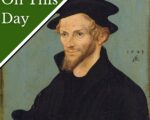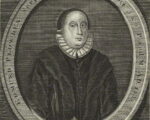
On 16th February 1497, German humanist, reformer and scholar, Philipp Melancthon, was born at Bretten in Germany.
Elizabeth I was said to have memorised his 1521 work “Loci Communes”.
Here are a few facts about this famous reformer
[Read More...]
On 16th February 1497, German humanist, reformer and scholar, Philipp Melancthon, was born at Bretten in Germany.
Elizabeth I was said to have memorised his 1521 work “Loci Communes”.
Here are a few facts about this famous reformer
[Read More...]
On this day in Tudor history, 15 February 1503, Henry Deane, administrator and Archbishop of Canterbury, died at Lambeth Palace at around the age of 63. He was laid to rest at Canterbury Cathedral in a lavish funeral.
Deane was the last monk to become Archbishop of Canterbury.
Let me give you a few facts about this archbishop…
[Read More...]
On this day in Tudor history, 14th February 1492, in the reign of King Henry VII, magnate William Berkeley, Marquis of Berkeley, died. He was buried in the Augustinian friary in London with his second wife, Joan.
Berkeley is known for his involvement in the 1470 Battle of Nibley Green, the last English battle fought between private armies of feudal magnates.
[Read More...]
On this day in Tudor history, 13th February 1564, in the reign of Queen Elizabeth I, astrologer and physician John Harvey was baptised at Saffron Walden in Essex.
Harvey was the third son of farmer and rope maker John Harvey and his wife, Alice. His brothers were renowned scholar Gabriel Harvey and astrologer and theologian Richard Harvey.
[Read More...]
On this day in Tudor history, 10th February 1564, in the reign of Queen Elizabeth I, Henry Neville, 5th Earl of Westmorland, died at Kelvedon in Essex.
Neville was born in around 1524/1525 and was the eldest son of Ralph Neville, 4th Earl of Westmorland, and his wife, Catherine Stafford. His maternal grandfather was Edward Stafford, 3rd Duke of Buckingham.
[Read More...]
Historian Claire Ridgway’s next online event, Henry VIII and His Six Wives, is open for registration with an early bird discount coupon!
Register now and join Claire, Dr Tracy Borman, Dr Linda Porter, Gareth Russell, Dr Owen Emmerson and Kate McCaffrey as they delve into the lives of this iconic king and his six queens consort.
Henry VIII and His Six Wives is a completely online event and its starts properly on 22nd May 2023. However, Claire is hosting zoom video calls twice a month leading up to the event so participants can get to know each other and talk Tudor. The zoom calls start on 12th February and the topic for discussion is Henry VIII in film and on TV.
[Read More...]
This day in Tudor history, 9th February 1554, in the reign of Queen Mary I, was one of the dates set for the execution of Lady Jane Grey, the former Queen Jane, but she was granted a three-day reprieve.
Why and what had happened between her trial in November 1553, when she had been condemned to death, and this day?
Let me tell you…
[Read More...]
On this day in Tudor history, 8th February 1545, in the reign of King Henry VIII, Sir John Arundell of Lanherne, died at the home of his nephew, Richard Roscarrock of Roscarrock, in St Endellion, Cornwall.
Let me give you a few facts about this Tudor man, who was actually the third John Arundell out of 9 prominent John Arundells in the same family…
[Read More...]
On this day in Tudor history, 7th February 1587, the warrant for the execution of Mary, Queen of Scots, arrived at Fotheringhay Castle in Northamptonshire, where Mary was being held.
Mary had been tried for treason in October 1586 after being implicated in the Babington Plot, a plot to depose Queen Elizabeth I and to replace her with Mary. She had been found guilty and sentenced to death, but Elizabeth would not sign the execution warrant, not wanting the responsibility of killing an anointed queen. However, Mary’s gaoler, Sir Amias Paulet, would not agree to quietly doing away with Mary, and after pressure from her council and petitions from Parliament, Elizabeth finally signed the warrant, although she later said she had asked for it not to be sent to Fotheringhay yet.
[Read More...]
On this day in Tudor history, 6th February 1585, lawyer, legal scholar and law reporter, Edmund Plowden, died in London.
Plowden was laid to rest in the Middle Temple Church.
Cambridge University’s libraries and the British Library contain manuscripts of his commentaries and opinions, and he is known for his 1571 volume of law reports covering cases during the reigns of Edward VI, Mary I and Elizabeth I.
[Read More...]

On 3rd February 1478, in the reign of King Edward IV, Edward Stafford, 3rd Duke of Buckingham, was born at Brecon Castle.
His father, the 2nd Duke of Buckingham, was executed as a traitor in Richard III’s reign and Edward came to the same end in 1521, in King Henry VIII’s reign.
Let me tell you a bit more about this Duke of Buckingham…
[Read More...]
On this day in Tudor history, 2nd February 1508, in the reign of King Henry VII, physician and Provost of King’s College, Cambridge, John Argentine died at King’s College.
He was about sixty-five years of age at his death. He was laid to rest in the Chantry Chapel at the college.
[Read More...]

On this day in Tudor history, 31st January 1547, Lord Chancellor Thomas Wriothesley announced the death of King Henry VIII to Parliament. The king had died on 28th January.
Chronicler and Windsor Herald Charles Wriothesley records the late king’s son, nine-year-old Edward, being officially proclaimed king
[Read More...]
On this day in Tudor history, 30th January 1520, in the reign of King Henry VIII, member of Parliament, Protestant, landowner and administrator, Sir William More, was born. More’s offices under Elizabeth I included Chamberlain of the Exchequer,
More was the only surviving son of Sir Christopher More of Loseley, a powerful administrator in Henry VII’s reign, and his wife, Margaret Mudge.
The Protestant More came to the forefront in the reign of Queen Elizabeth I, serving her as Constable of Farnham Castle, Treasurer of the Lottery, Commissioner for Ecclesiastical Causes, Collector of the Loan, Master of Swans and Deputy Custos Rotulorum, as well as Chamberlain of the Exchequer. He was also a commissioner on various commissions of oyer and terminer during her reign.
[Read More...]
On this day in Tudor history, 28th January 1501, in the reign of King Henry VII, politician and administrator John Dynham, 1st Baron Dynham, died at his home at Lambeth. He was buried at the London Greyfriars on 30th January.
Here are a few facts about this Tudor baron…
[Read More...]
On this day in Tudor history, 27th January 1556, in the reign of Queen Mary I, Protestant Bartlet or Bartholomew Green was burnt at the stake at Smithfield, with six other Protestants.
Green, who martyrologist John Foxe describes as a gentleman and lawyer, “saw the true light of God’s gospel” when listening to lectures given by Peter the Martyr while studying at Oxford. Foxe writes that “Whereof when he had once tasted, it became unto him as the fountain of lively water, that our Saviour Christ spake of to the woman of Samaria, so as he never thirsted any more, but had a well springing unto everlasting life”. Green studied law at the Inner Temple at London.
[Read More...]
On this day in Tudor history, 26th January 1528, in the reign of King Henry VIII, courtier and diplomat Sir Francis Poyntz died in London. He died of the plague.
Poyntz, who was about 31 at his death, was the third son of courtier, Sir Robert Poyntz, of Iron Acton in Gloucestershire, and his wife, Margaret, an illegitimate daughter of Anthony Woodville, 2nd Earl Rivers. Francis was made an Esquire of the Body to Henry VIII in 1516, and then a Carver in 1521.
[Read More...]
On this day in Tudor history, 25th January 1540, St Edmund Campion, Jesuit and martyr, was born in London.
Campion was hanged, drawn and quartered on 1st December 1581 for treasonable conspiracy. He was beatified in 1886 by Pope Leo XIII and canonized in 1970 by Pope Paul VI.
[Read More...]
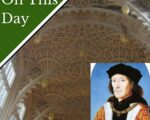
On this day in Tudor history, 24th January 1503, the foundation stone of King Henry VII’s chapel, a large Lady Chapel, at Westminster Abbey, was laid.
At the time, Henry VII planned for the chapel to be a shrine to King Henry VI, who was expected to be canonised, but this never happened.
The chapel was completed in 1516, in the reign of Henry VII’s son, King Henry VIII, and became the burial place of fifteen kings and queens, including Henry VII and his wife, Elizabeth of York, who have beautiful gilt-bronze effigies, and their grandchildren Edward VI, Elizabeth I and Mary I, and great-granddaughter, Mary, Queen of Scots. Others buried there in the Tudor period include, Lady Margaret Beaufort, Henry VII’s mother, and Lady Margaret Douglas, his granddaughter.
[Read More...]
On this day in Tudor history, 23rd January 1570, James Stewart, 1st Earl of Moray, illegitimate son of James V, half-brother of Mary, Queen of Scots, and a man who was acting as regent for his half-nephew, King James VI, was assassinated.
Moray, who was about 38 or 39 years of age at his death, had become regent for his one-year-old half-nephew following the abdication of Mary, Queen of Scots. Mary, who was imprisoned at the time, had been forced to abdicate by the confederate lords following her defeat at Carberry Hill.
[Read More...]
On this day in Tudor history, 22nd January 1561, Francis Bacon, Viscount St Alban, was born at York House in the Strand, London.
[Read More...]
On this day in Tudor history, 21st January 1556, imperial ambassador Eustace Chapuys died in Louvain, the place he had retired to in 1549. He was laid to rest in the chapel of Louvain College, the college he had founded.
Chapuys is one of my favourite sources for the reign of Henry VIII because his dispatches to the emperor and his fellow ambassadors are so detailed.
But who was Eustace Chapuys? Let me tell you a bit more about him…
[Read More...]
On this day in Tudor history, 20th January 1558, in the final year of Queen Mary I’s reign, there was the state opening of Mary’s fifth Parliament.
As Cedric Ward points out in his article “The House of Commons and the Marian Reaction”, by this time, due to Mary’s marriage to Philip of Spain, England was allied with Spain in its war against France so Parliamentary business focused on financial and military items.
[Read More...]On this day in Tudor history, 19th January 1561, in the reign of Queen Elizabeth I, Sir Edward Carne died in Rome. He was about sixty-five years of age.
The administrator and diplomat, who came from Glamorgan in Wales originally, carried out diplomatic missions for King Henry VIII, was a royal commissioner during the dissolution of the monasteries, negotiated for a fourth marriage for Henry VIII after the death of Jane Seymour, was Mary I’s English ambassador to Rome, and claimed descent from the Kings of Gwent! An interesting man.
[Read More...]
On this day in Tudor history, 18th January 1543, composer, court musician and perhaps spy Alfonso Ferrabosco was baptised at the Cathedral of San Petronio, in Bologna, Italy.
Why am I talking about an Italian composer and musician?
Well, because he worked at Queen Elizabeth I’s court and is said to have been responsible for the growth of the madrigal at the royal court.
Here are some facts about this Italian composer and musician…
[Read More...]
On this day in Tudor history, 17th January 1587, Bartholomew Newsam (Newsum, Newsham), died. He was buried in the church of St Mary-le-Strand, the parish in which he lived and worked. He was in his fifties at his death.
Bartholomew Newsam, who is thought to have come from the York area, was a famous clockmaker, sundial maker and scientific instrument maker. He worked for Queen Elizabeth I, repairing clocks and perhaps even making them for her.
[Read More...]