
On this day in Tudor history, 18th September 1535, in the reign of King Henry VIII, Henry Brandon, 2nd Duke of Suffolk, was born.
Henry would not have a long life, dying at the age of fifteen from sweating sickness.
[Read More...]
On this day in Tudor history, 18th September 1535, in the reign of King Henry VIII, Henry Brandon, 2nd Duke of Suffolk, was born.
Henry would not have a long life, dying at the age of fifteen from sweating sickness.
[Read More...]
On this day in Tudor history, 6th September 1572, in the reign of Queen Elizabeth I, Sir Henry Jerningham (Jernegan) died at his manor of Costessey in Norfolk. He was buried in the parish church there.
Jerningham served Henry VIII and Mary I, and his offices in Mary’s reign included privy councillor, Vice-Chamberlain of the Household, and Captain of the Yeomen of the Guard. He was instrumental in helping Mary in the succession crisis of 1553.
[Read More...]
On this day in Tudor history, 25th June 1503, seventeen-year old Catherine of Aragon became betrothed to the nearly twelve-year old Prince Henry, second son of King Henry VII.
Catherine had been widowed in April 1502 when her husband, Arthur Tudor, Prince of Wales, eldest son of Henry VII, died. The king was keen to keep hold of her dowry so negotiated with her parents, Isabella I of Castile and Ferdinand II of Aragon, for her to marry his second son.
[Read More...]
The 15th June 1519 is the traditional birthdate of Henry VIII’s illegitimate son, Henry Fitzroy, Duke of Richmond and Somerset, although the 18th is a more likely date.
Fitzroy’s mother, Elizabeth Blount, known as Bessie Blount, was serving as one of Catherine of Aragon’s maids of honour when she was noticed by the king and became his mistress. After it was found that she was pregnant, she was sent to the Priory of St Lawrence, in Blackmore, Essex, by Cardinal Thomas Wolsey before her pregnancy became visible.
Bessie’s baby boy was baptised at the chapel at Blackmore with Cardinal Wolsey acting as godfather.
[Read More...]
On this day in Tudor history, 5th May 1586, in the reign of Queen Elizabeth I, fifty-six-year-old Sir Henry Sidney died. His body was buried in the Sidney Chapel at Penshurst and his heart in Ludlow, where he lived as President of the Council in the Marches of Wales.
[Read More...]
King Henry VII is often neglected in favour of his seemingly more interesting son, Henry VIII, or granddaughter, Elizabeth I, but he is a fascinating historical character.
In this week’s “from the archives”, historian Nathen Amin, author of The House of Beaufort and Henry VII and the Tudor Pretenders: Simnel, Warbeck, and Warwick, talks about Henry VII: the Man…
[Read More...]
On this day in Tudor history, 7th April 1498, King Henry VII’s contemporary, King Charles VIII of France, died.
Charles the Affable, as he was known, died after hitting his head on a lintel at the Chateau d’Amboise while on his way to watch a tennis match. He made it to the match, but after the game, he was taken ill, slipped into a coma and died. He’d been king since 1483.
[Read More...]
On this day in Tudor history, 6th April 1523, in the reign of King Henry VIII, nobleman and courtier Henry Stafford, Earl of Wiltshire, died at the age of about 44.
Stafford died without issue so his earldom became extinct until 1529 when Thomas Boleyn, father of Anne Boleyn, was made Earl of Wiltshire.
[Read More...]
On this day in Tudor history, 31st March 1509, the dying Henry VII made his last will and testament at Richmond Palace, three weeks before his death.
The will was based on an earlier draft, with some new provisions added, for example, the addition of Sir Richard Empson and Edmund Dudley to the list of executors.
[Read More...]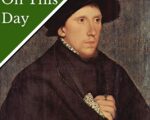
On this day in Tudor history, 22nd March 1546, Edward Seymour, Earl of Hertford, landed in Calais to relieve the out of favour Henry Howard, Earl of Surrey, in his military duties as lieutenant general there.
Hertford had been officially appointed the previous day “as the King’s lieutenant in the parts beyond sea, and commander in chief of the army and armada now about to be sent thither; with authority to invade France at discretion, and to order all admirals, vice-admirals and shipmasters there.” The privy council also wrote to Surrey recalling him to England.
But what had happened? Why was Surrey being replaced with Hertford?
[Read More...]
On this day in Tudor history, 4th March 1526, in the reign of King Henry VIII, courtier and administrator, Henry Carey, 1st Baron Hunsdon, was born.
Hunsdon was the only son of Mary Boleyn and her first husband, William Carey, esquire of the body to Henry VIII. There is controversy over his paternity due to Mary Boleyn having a sexual relationship with Henry VIII at some point…
[Read More...]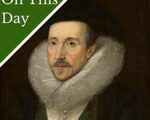
On this day in Tudor history, 24th February 1540, in the reign of King Henry VIII, courtier, author and administrator, Henry Howard, Earl of Northampton, was born at Shottesham in Norfolk.
Northampton was the second son of courtier and poet Henry Howard, Earl of Surrey, and his wife, Lady Frances de Vere.
Let me give you a few facts about this Tudor earl…
[Read More...]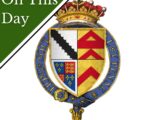
On this day in Tudor history, 17th February 1557, Henry Radcliffe, 2nd Earl of Sussex, died at Cannon Row in Westminster. He was buried firstly at St Laurence Pountney and then moved to Boreham in Essex.
Sussex, who was about 50 at his death, was the son of courtier and soldier Robert Radcliffe, 1st Earl of Sussex. He accompanied the king and Anne Boleyn on their 1532 Calais visit and was made a Knight of the Bath in the celebrations for Anne’s coronation in 1533. He commanded men under the Duke of Norfolk in Henry VIII’s French campaign in 1544 and was lord sewer at Edward VI’s coronation in 1547.
[Read More...]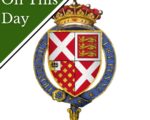
On this day in Tudor history, 10th February 1564, in the reign of Queen Elizabeth I, Henry Neville, 5th Earl of Westmorland, died at Kelvedon in Essex.
Neville was born in around 1524/1525 and was the eldest son of Ralph Neville, 4th Earl of Westmorland, and his wife, Catherine Stafford. His maternal grandfather was Edward Stafford, 3rd Duke of Buckingham.
[Read More...]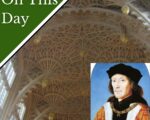
On this day in Tudor history, 24th January 1503, the foundation stone of King Henry VII’s chapel, a large Lady Chapel, at Westminster Abbey, was laid.
At the time, Henry VII planned for the chapel to be a shrine to King Henry VI, who was expected to be canonised, but this never happened.
The chapel was completed in 1516, in the reign of Henry VII’s son, King Henry VIII, and became the burial place of fifteen kings and queens, including Henry VII and his wife, Elizabeth of York, who have beautiful gilt-bronze effigies, and their grandchildren Edward VI, Elizabeth I and Mary I, and great-granddaughter, Mary, Queen of Scots. Others buried there in the Tudor period include, Lady Margaret Beaufort, Henry VII’s mother, and Lady Margaret Douglas, his granddaughter.
[Read More...]
On 13th January 1593, in the reign of Queen Elizabeth I, Sir Henry Neville died. He was buried at Waltham St Lawrence in Berkshire.
Sir Henry Neville was a groom of Henry VIII’s Privy Chamber and a gentleman of Edward VI’s Privy chamber.
[Read More...]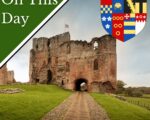
On 8th January 1570, in the reign of Queen Elizabeth I, Henry Clifford, 2nd Earl of Cumberland, died at his home, Brougham Castle. He was buried at Holy Trinity Church, Skipton.
According to a family story, Clifford was so devastated at the death of his first wife, Lady Eleanor Brandon, that he could only be brought back from a certain death by suckling from a woman’s breasts!
[Read More...]
On this day in Tudor history, 30th June 1559, King Henry II of France, suffered a mortal injury.
The keen sportsman was injured while jousting. He died on 10th July and was succeeded by his son, Francis II.
Jousting was a dangerous sport and Henry was fatally injured when splinters from his opponent’s lance entered his right eye.
Find out more about Henry II’s accident and death, and also his reign in this video…
[Read More...]
On this day in history, 29th April 1617, Sir Dru Drury died at the age of around 85 at his home, Riddlesworth Hall in Norfolk.
Drury may have died in the Stuart period, but he was a prominent Elizabethan. And he’s a man that went from being a prisoner to being Lieutenant of the Tower of London! Find out more about him…
[Read More...]

On this day in Tudor history, 13th March 1540, sixty-eight-year-old Henry Bourchier, 2nd Earl of Essex, died after suffering a broken neck in a horse-riding accident. Chronicler Charles Wriothesley recorded: “the Earl of Essex, riding a young horse, by misfortune cast him and brake his neck at his place in Essex, which was great pity.”
Henry Bourchier, 2nd Earl of Essex, was related to the royal family and served both Henry VII and Henry VIII.
Find out more about this Tudor man in this talk…
[Read More...]
On this day in Tudor history, 5th February 1549, in the reign of King Edward VI, fifteen-year-old Elizabeth, the future Queen Elizabeth I, was summoned to appear before Sir Robert Tyrwhitt, who was keeping her under house arrest at Hatfield while the Crown investigated Thomas Seymour.
Edward VI’s privy council were investigating whether Elizabeth was secretly plotting to marry Thomas Seymour, Edward VI’s uncle, helped by her servants, Katherine Ashley and Thomas Parry.
Parry and Ashley had made confessions, but what had they said? And what would happen to them all?
[Read More...]
On this day in Tudor history, 2nd December 1586, following a joint petition from the Houses of Lords and Commons, Elizabeth I finally agreed to a public proclamation of sentence against Mary, Queen of Scots: death.
Mary had been found guilty of high treason back in October 1586, but Elizabeth had not wanted to contemplate regicide. However, Parliament believed that if Mary, Queen of Scots, was not executed, that she’d continue to plot against Elizabeth and would utterly “ruinate and overthrow the happy State and Common Weal of this most Noble Realm”. She was too much of a danger and needed dealing with once and for all.
Find out what Parliament said and what happened next in this talk…
[Read More...]
On this day in Tudor history, 26th November 1585, Catholic priest Hugh Taylor and his friend Marmaduke Bowes were hanged at York.
They were the first men executed under Elizabeth I’s 1585 statute which made it treason to be a Jesuit or seminary priest in England or to harbour such a priest.
These two Catholics were beatified in 1987 by Pope John Paul II as two of the 85 Martyrs of England, Scotland and Wales.
Find out more about these men and what this 1585 legislation was all about in this talk…
[Read More...]
On this day in Tudor history, 7th November 1485, Henry VII’s first parliament attainted King Richard III and his supporters.
As well as Richard, who was referred to as Richard, late Duke of Gloucester, and a usurper, the list of those attainted for their treason in fighting against the king at Bosworth included the late John Howard, 1st Duke of Norfolk, and his son, the Earl of Surrey.
Find out who else was included and whether Parliament’s actions were unusual, in this talk…
[Read More...]
On this day in Tudor history, 17th September 1558, Walter Devereux, 1st Viscount Hereford and grandfather of Robert Devereux, 2nd Earl of Essex and a favourite of Elizabeth I, died at the Devereux family seat at Chartley in Staffordshire.
Devereux had a long and distinguished court career, serving Henry VIII, Princess Mary in Ludlow, and Edward VI. He also married at around the age of 11 and was imprisoned at one point. An interesting Tudor man.
Find out more about this soldier and royal servant…
[Read More...]
On 25th June 1503, the widowed Catherine of Aragon got betrothed to Prince Henry, second son of King Henry VII.
Find out more about this, the plans for their marriage, and what happened, in this edition of #TudorHistoryShorts…
[Read More...]
As my latest “Facts about…” video is about the very first Tudor monarch, King Henry VII, I thought I’d share it here.
Henry VII does seem to be a neglected monarch, as many people find his son, Henry VIII, and his granddaughter, Elizabeth I, far more interesting, but he deserves some attention, don’t you think?
[Read More...]
On this day in Tudor history, 23rd May 1547, in the reign of King Edward VI, Henry Grey, 3rd Marquis of Dorset, was finally installed as a Knight of the Garter.
Grey had wanted this honour for years and had been nominated many times, so what had changed? How did he end up joining the Order of the Garter.
Find out in this video…
[Read More...]
In this first part of This Week in Tudor History, I talk about Henry Howard, Earl of Surrey’s loss of royal favour after the English defeat in France, but his children’s joy at the news of him returning home; ambassador Sir Henry Unton (or Umpton) who was killed in France by the “purple fever”, and Sir James Dyer, a Chief Justice who has gone down in history as the first law reporter.
[Read More...]