
Here at the Tudor Society, we love author and historian Toni Mount. For many years she was a contributor to our monthly magazine, and our sister publishing company, MadeGlobal Publishing, publishes her medieval murder mystery series. The latest book in her series (book 14!) is called The Colour of Malice. Toni joins us with a guest article.
 I was asked how I chose the titles for my novels. Well first we have the artistic connection: Sebastian Foxley, is a talented medieval illuminator, artist, and bookseller. Because his life revolves around mixing inks, paints, and pigments in his London workshop, every mystery in the series links the word "The Colour of..." to a specific theme, crime, or motive dominating that particular story.
The Thematic Element: In this 14th book, the word "Malice" hints directly at the dark driving force of the plot. While preceding books used tangible elements or vices - such as The Colour of Poison (murder by toxins), The Colour of Bone (a discovered skeleton), or The Colour of Evil (counterfeiting and greed) - this title signals a mystery deeply rooted in spite, long-held grudges, and deliberate ill-will.
The Colour of Malice is the fourteenth instalment of Seb’s adventures and I needed something new. In medieval London the means of murder are limited and I’ve used most of them so I looked at the historic documents and discovered that the first recorded death caused by a fire-arm was in the 1520s. I thought this was quite late as handguns were around a lot earlier – th crucial point about this fact is that it was the first recorded incident – that doesn’t mean that murders could have occurred before but were not recorded – so whay not in medieval London circa 1482?
Prologue to The Colour of Malice
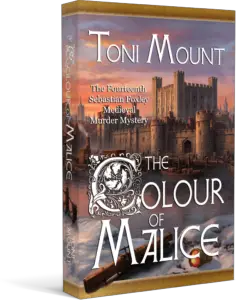 It had been an afternoon of celebration at the Cardinal’s Hat in Cornhill. Widow Ventham wasn’t certain what the four men were celebrating, but they had reserved her back parlour, in advance, for the cost of eight pence and, so long as they behaved reasonably in her most respectable house, she was content to serve them with food, sweetmeats, ale and wine until they should depart. She prided herself that her inn sold the best victuals and provided the cleanest accommodation in London.
The four looked to be the middling sort—neither wealthy merchants nor poor artisans—well clad but without ostentation. Sabina Ventham, widowed these three years past, appraised every male customer with a view to partnership at bed and board and here at the table was a group of possibilities.
As to their years, judged with a knowledgeable regard, one was in his late twenties, of an olive complexion, dark of hair and eye, and quite comely. She wondered if he was an incomer from warmer lands, although by his speech he sounded to be as English as King Edward. But he seemed of a nervous disposition, his hands never still. In such a man she sensed a lack of maturity, whereas she required one with some experience.
Another was in his forties, she would hazard a guess, somewhat stout, broad at shoulder and still with a full head of brown curls, grey streaked about his ears. Not bad and worth considering. She could picture him hefting ale firkins without too much difficulty.
The other two looked to be in between, in their thirties. Of the pair, the balding, thin-lipped fellow she did not take to, but the other was handsome and smiled at her whenever she caught his eye—which was often indeed. Well, all things considered, she was a fine-looking woman, so she reckoned, and she owned this prosperous inn—a fair catch for any man. Thus, even as she wondered at this fourth fellow’s name, she paid him particular attention, filling his cup to the very brim and giving him the most generous portions of meat. Blue-eyed and with good white teeth… who could say how things might turn out if she did right by him?
The short winter’s day was drawing to a close, and the wine yet flowed in the back chamber. The men asked for the fire to be replenished as the night chills crept in under the door and betwixt the window shutters. Candles were called for. The laughter was becoming more raucous; the jests more bawdy, but so long as they settled up the reckoning at the end, all would be well.
As she went in with a five-sconce pewter candelabra—no expense spared—the men were examining some strange device, passing it around among themselves. It looked to be a hollow pipe about the length of a man’s forearm with an ornamented handle. She had never seen the like. It seemed heavy in their hands.
‘Does it work, though, Jenkyn?’ the youngest of the quartet asked.
‘Of course it does, and cheap at the price, if you want it? Ten marks is a bargain, as I told you,’ the stout older man said.
The thin-lipped man whistled:
‘My best mare cost less than that.’
‘How did you come by it?’ the handsome one wanted to know.
‘Never you mind. Give it here. I’ll show you how it works now we’ve got candles to see by.’
Widow Ventham put a couple of ash logs on the fire and stoked the flames to a goodly blaze. Sparks rose, dancing up the chimney.
‘Can I fetch you gentlemen anything else?’ She patted her cap and straightened her apron. ‘We have a mutton pie fresh from the oven?’
‘Pie would be good,’ the thin-lipped fellow said as she reached the door.
‘Very well, good masters.’
At that moment, the world seemed to tilt. Lightning flashed, thunder roared and smoke filled the back parlour as Hell erupted in Cornhill. Widow Ventham staggered, clutching the door jamb to keep upright. Shouts and cries came from within the smoke. There was a strange, acrid smell. She was coughing, her eyes watering as she turned to see what had come to pass in her most respectable house.
Two men stood; the third was down on his knees beside the fourth, who lay prone amidst the floor rushes. Which of them it was she could not tell for the face was naught but a mask of blood. She felt dizzy with the horror of it.
Death, in some new gore-soaked guise, had come to the Cardinal’s Hat.
Leave a Reply