
Today we have a guest article from Roger Drexler who has been spending time researching Edward Seymour in advance of writing a new biography of this fascinating Tudor man.
Here, he's shared an article about Edward Seymour's first marriage. Take it away, Roger:
The Scandalous First Marriage of Edward Seymour
“Old Sir John is a man of notorious family feeling. Two, three years back, the gossip at court was all of
how he had tupped his son’s wife, not once in the heat of passion but repeatedly since she was a bride”.
“The traitor wife gave birth to two boys, and when her conduct came to light Edward said he would not
have them for his heirs, as he could not be sure if they were his sons or his half brothers. The adulteress
was locked up in a convent, and soon obliged him by dying…”
Hilary Mantel, Bring up the Bodies
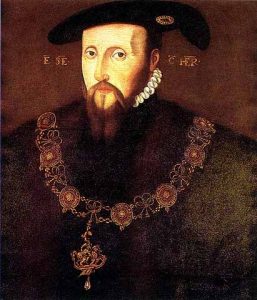 It has been whispered over the centuries that Edward Seymour, long before he became Duke of Somerset and Lord Protector of the Realm during the reign of his young nephew King Edward VI, repudiated his first wife Catherine Fillol, dissolved their marriage, and consequently banished her to a convent for the remainder of her days. The cause of her husband’s wrath was Catherine’s infidelity, more specifically, having conducted a lengthy affair with none other than her father-in-law, the steadfast royal servant Sir John Seymour. Unfortunately, if this disreputable saga of seduction and betrayal had truly befallen the family, none of the details can be proven with any degree of certainty.
In the award-winning historical novel Bring up the Bodies, the second volume in her trilogy depicting the life and machinations of King Henry VIII’s chief minister Thomas Cromwell, Hilary Mantel’s portrayal of Catherine Fillol as her father-in-law’s lover was surely an anecdote far too shocking and salacious to exclude from her book. As an author of historical fiction, sticking exclusively to established facts would be a needless constraint in weaving riveting plotlines and developing compelling characters and themes.
Mantel said in describing her approach to writing, “I track the historical record so I can report the outer world faithfully – though I also tell my reader the rumors”. Recounting the challenges she faced in conceptualizing her novels, Mantel revealed “what I wasn’t prepared for were the gaps, the erasures, the silences where there should have been evidence.” Fleshing out her stories with the rumors helped her overcome the limits imposed by verifiable deeds and events, allowing her “to start practicing my trade at the point where the satisfactions of the official story break down”.
Attempting to construct an accurate historical account, on the other hand, is complicated by the fact that if the affair and its acrimonious aftermath did occur, not a single identified contemporary letter, diary or eyewitness account makes reference to it. The record also fails to mention the slightest enmity between Edward and his father, nor is there any sign the scandal slowed the Seymour’s steady rise as royal favorites. King Henry paid Sir John and the family the great honor of visiting their ancestral home of Wolf Hall on his royal progress in 1535, and when the king’s own volatile marriage to his second queen Anne Boleyn soon began to unravel, his eye turned to Edwards’s sister Jane as his next bride, with Edward acting as his most trusted confidant in facilitating the blossoming romance.
Even had an illicit relationship been discovered, there were good reasons why word of this shameful episode was not widely circulated at the time. It is clear the ambitious Seymour clan would have a strong motivation to keep their predicament under wraps, and despite internal stresses would band together to protect their collective reputations and future prospects. The same would apply to respected country gentry like the Fillols, who would have no desire to allow the transgressions of a wayward daughter become public knowledge. If there was a concerted cover-up, it appears to have been remarkably successful. A family as aspiring and relentless as the Seymours inevitably had enemies and rivals who would look to exploit any indignity to damage one of their competitors in the zero-sum
game that was Tudor court politics. One foe was Arthur Plantagenet, Lord Lisle, who not long after the marriage had failed was involved in a bitter legal dispute with Edward over property in Somerset. Lisle wrote numerous letters to friends and allies airing his complaints, even petitioning the powerful Cromwell to support his claims. If armed with knowledge of the affair, it seems unlikely the aggrieved Lisle would have bypassed the opportunity to privately smear his adversary and sully the Seymour name.
Nonetheless, by piecing together the historical speculation and rumors with the circumstantial evidence, a plausible case can be made that Catherine and her father-in-law were guilty, or at least suspected, of adultery, and the allegations were serious enough to lead to the end of her marriage and ostracism from polite society.
Catherine was the daughter of Sir William Fillol, a well-respected and prosperous Dorset and Essex landowner. As a young girl of uncertain age, in a match orchestrated by her father and Sir John, she was betrothed to Edward, and by 1518 the two were married. Due to the prearranged nature of the wedding, there had likely been no courtship or falling in love, and while Catherine was sent to reside at Wolf Hall under the guardianship of her father-in-law, the newlyweds would not have lived together as man and wife until she came of age, which for Tudor-era girls was the early teenage years. While they were his wards, Sir John was responsible for supporting the couple with sufficient “meat, drink, learning and lodging”, and “apparel convenient to their degree”. In typical acquisitive Seymour fashion, the union held great promise, as Catherine and her sister were Sir William’s co-heirs and along with their husbands poised to inherit considerable manors and properties. On the surface all seemed to be going according to script, and though the timeline is vague, in due course Catherine gave birth to two sons.
From the beginning of the marriage, the serious-minded and driven Edward, as a rising courtier, was often absent from Wolf Hall and his wife. While Edward was away at university, court or overseas, the aging but still vigorous Sir John, now spending far less of his time attending the king as a Knight of the Body in London, was regularly in close proximity to his lonely and possibly flirtatious daughter-in-law. The charming and virile father of ten had already publicly recognized one illegitimate son by an unknown mother, and he may have looked upon Catherine with a covetous eye as she grew into an attractive young woman. If at some point they did abandon self-restraint and act on their amorous desires, we can only guess as to the timing and extent of the affair, or even if it were consensual from Catherine’s perspective. Wolf Hall manor, standing a mile outside of the Royal Forest of Savernake and centered on a large property of 1,270 acres including several gardens, parks and a large thatched roofed
barn, certainly would have offered the requisite hidden corners and secluded woods for forbidden lovers to conceal a long running liaison.
Whatever may or may not have unfolded, accusations of wrongdoing were not made until the seventeenth century, long after the protagonists had passed from the scene, when two obscure testimonials first refer to Edward Seymour as a cuckold, and his wife an adulterer. One is a fantastical tale by ecclesiastical writer Peter Heylyn from his History of the Reformation of the Church of England. Heylyn declared that while in France, Edward “did there acquaint himself with a learned man” who “let him see, by the help of some magical perspective”, what appeared to be “a gentleman of his acquaintance in a more familiar posture with his wife than was agreeable to the honor of either party”.
To this “diabolical illusion”, Edward is said “to have given so much credit that he did not only estrange himself from her society at coming home, but furnished his next wife with an excellent opportunity for pressing him to the disinheriting of his former children”.
The second clue, a short marginal note embedded in Vincent’s Baronage, a collection of genealogical history by the antiquarian Augustine Vincent, supports Heylyn’s underlying assertion and directly implicates Sir John. Written in Latin, the translation simply states that Catherine was “Repudiated because she was known by father after the wedding”. This “very curious anecdote” was delved into with great interest when discovered by the literary circle of the renowned eighteenth-century author and politician Horace Walpole, and has intrigued writers and scholars ever since. A possible source of the allegations was a vicious parliamentary dispute in 1604 involving the competing heirs of Edward’s two marriages. During a quarrel over “certain manors, lands and tenements”, between Edward’s son the Earl of Hertford and his grandson Sir Edward Seymour, many “sundry bitter terms of spleen and imputation, to themselves, and their ancestors, passed between them”. Included in the vitriol was Hertford’s claim
that “that John, the eldest son of all, was begotten while Edward was in France”.
Setting aside the authenticity of a French seer with clairvoyant powers or the dependability of a provocative marginal note that fascinated antiquarians with a taste for hearsay, something drastic did happen to the marriage, and the fallout was apparent. It seems that sometime before 1530 Catherine had been shut away in a convent, by 1535 Edward was remarried, and in 1540 through an Act of Parliament he disinherited his eldest son by Catherine. The most reliable piece of evidence indicating all was not well with the marriage was the altering of Sir William Fillol’s will, dated May 14, 1527. While an earlier version from 1519 had named Catherine co-executor, by 1527 Sir William was clearly finished with both his daughter and the Seymours, avowing that in regard to the inheritance of his estates “for many diverse causes and considerations”, neither “Catherine nor her heirs of her body nor Sir Edward Seymour her husband in any ways shall have any part or parcel”.
In his disappointment and anger Sir William was not completely indifferent to his daughter’s fate, and wanting to ensure she was well cared for agreed to pay her the then significant pension of forty pounds a year “as long as she shall live virtuously and abide in some honest house of religion of women to the pleasing of God”. Edward evidently had reason to take his father-in-law up on this offer, demonstrating the degree of his own dissatisfaction with his dubious bride. While it is feasible that Catherine of her own accord wished to take religious vows, convalesce from an illness, or the marriage had come undone for reasons other than adultery, it is clear the couple were soon separated and living apart.
Although he did not formally divorce Catherine, an untainted Edward was now left at liberty to refocus on what he did best, accumulating wealth and enhancing his standing at court. In 1530 he used his growing influence to have Sir William’s will invalidated by an Act of Parliament, on the grounds the old man was “having many sundry and inconstant fantasies in his latter days”. While it is possible Sir William had actually come unhinged, as he was also feuding with his other daughter, this scheme allowed Edward to control considerably more than his rightful share of the Fillol inheritance.
In 1535, after Catherine was believed to have died, Edward married his second wife, the domineering Anne Stanhope, in what proved to be a far more suitable and advantageous arrangement. Probably at her bidding he later disinherited his first son by Catherine and passed over the second in favor of his children by Anne. That Edward did not entirely exclude his youngest son from the line of succession may imply that he had discovered the duration of Catherine’s infidelity, and therefore only suspected the paternity of the eldest. Horace Walpole would write scoldingly of the “great injustice” that had been done “to the children of his first wife, in favor of those by his second”, yet over the years Edward continued to lend support to both boys, buying them clothing and providing for their education, as long as they stayed well out of sight of their disapproving stepmother, “a lady of a high mind and haughty undaunted spirit”.
Meanwhile, as Sir John’s status and reputation apparently remained unscathed, all traces of Catherine Fillol vanish from history following the amending of her father’s will in 1527. If indeed she had been secreted away in a “house of religion”, there behind the convent walls she presumably spent the rest of her days in needlework and prayer, living a chaste life with few if any visitors, and died in anonymity, silently taking with her to the grave the truth concerning her conduct and the demise of her ill-fated marriage. In the end, while Hilary Mantel’s fictionalized Queen Anne Boleyn in Bring Up the Bodies can take great pleasure in gossiping about the scandal and spreading the rumors at court, those endeavoring to decipher the “official story” are limited to a few tangential clues, after-the-fact accounts of questionable validity, and much room for musing and conjecture. This leaves us with more questions than answers, craving the discovery of some long-lost chronicle to pry open the door on this Seymour family drama, and shed a ray of light on what really transpired amongst them some five hundred years
ago.
ABOUT ROGER DREXLER
Roger Drexler is a writer living in Chevy Chase, MD. He’s currently working on a biography of Edward
Seymour.
Sources:
- Cardigan, C.S. The Wardens of Savernake Forest. London: Routledge & Kegan Paul, 1949.
- Loades, David. The Seymours of Wolf Hall: A Tudor Family Story. Stroud: Amberley Publishing, 2015.
- Locke, A. Audrey. The Seymour Family: History and Romance. London: Constable, 1911.
- Mantel, Hilary. Bring Up the Bodies. New York: Picador, 2012.
- Scard, Margaret. Edward Seymour, Lord Protector: Tudor King in All But Name. The History Press, 2016.
- Wier, Alison. The Six Wives of Henry VIII. New York: Grove Press, 1991.
- Beer, Barrett L. "Seymour, Edward, Duke of Somerset (c. 1500–1552)." In Oxford Dictionary of National
Biography. Oxford: Oxford University Press, 2004. http://www.oxforddnb.com/view/article/25159. - Bryson, Sarah. “Edward Seymour, Duke of Somerset”. The Tudor Society. Accessed February 17, 2026.
https://www.tudorsociety.com/edward-seymour-duke-somerset/ - Dunn, Suzannah. "Extra Material for The May Bride." Suzannah Dunn. Accessed February 17, 2026.
https://www.suzannahdunn.co.uk/extra-material-for-the-may-bride/ - Hasler, P.W. "SEYMOUR, Edward (c.1563-1613), of Berry Pomeroy, Devon." In The History of Parliament:
The House of Commons 1604-1629, edited by Andrew Thrush and John P. Ferris. Cambridge: Cambridge
University Press, 2010. https://www.historyofparliamentonline.org/volume/1604-
1629/member/seymour-edward-1563-
1613#:~:text=and%2020%20June).21%20Devon,the%20bill%20later%20that%20day - Hawkyard, A. D. K. "SEYMOUR, John II (by 1518-52), of London." In The History of Parliament: The House
of Commons 1509-1558, edited by S. T. Bindoff. London: Secker & Warburg, 1982.
https://www.historyofparliamentonline.org/volume/1509-1558/member/seymour-john-ii-1518-
52#footnote3_e1hcpsl - Higginbotham, Susan. "The Marital Misadventures of Edward Seymour." History Refreshed (blog),
Accessed February 17, 2026. https://www.susanhigginbotham.com/posts/the-marital-misadventures-
of-edward-seymour/ - Larson, Rebecca. "Edward Seymour: Father or Brother?" Tudors Dynasty. November 28, 2015.
https://tudorsdynasty.com/edward-seymour-father-or-brother/ - Larson, Rebecca. "The Other Seymours: John Seymour, Son of Katherine Fillol." Tudors Dynasty. October
24, 2020. https://tudorsdynasty.com/the-other-seymours-john-seymour-son-of-katherine-fillol/#more-
15107 - Mantel, Hilary. "Hilary Mantel: Why I Became a Historical Novelist." The Guardian, June 3,
2017. https://www.theguardian.com/books/2017/jun/03/hilary-mantel-why-i-became-a-historical-
novelist. - "Scandal in the Seymours by Alison Weir." H for History (blog). January 9, 2019.
https://hforhistory.co.uk/h-for-history-posts/2019/01/09/scandal-in-the-seymours-by-alison-weir/ - Tudor Times, "Edward Seymour: Rising," accessed February 20, 2026,
https://tudortimes.co.uk/people/edward-seymour-life-story/rising - Under These Restless Skies (blog). "Catherine Fillol." November, 2013. https://under-these-restless-
skies.blogspot.com/2013/11/catherine-fillol.html. - Walpole, Horace. The Letters of Horace Walpole, Earl of Orford — Volume 4. FullBooks.com.
http://www.fullbooks.com/The-Letters-of-Horace-Walpole-Volumex79563.html.

The danger in evaluating incidents of “adultery” or promiscuity is in failing to understand the total and unmitigated dependence of married noble women on their lords and protectors (this would include Somerset, her father-in-law) who was a known high-stakes manipulator, land-stealer, and, it would not be surprising, to find the old man guilty of crimes against his daughter-in-law as well. To characterize the situation as mutually amorous would have little foundation given that Edward Seymour was absent, off managing fifteen-year-old Edward VI’s kingdom, present when Seymour’s brother, Thomas, attempted to assassinate the young king and a bit later when the boy died, likely of poisoning.