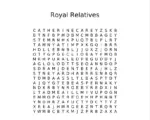
This Sunday’s Tudor Society puzzle tests your knowledge of royal relatives.
How much do you know about the men and women who were related to the Tudor kings and queens?
Find out with this fun word search.
[Read More...]
This Sunday’s Tudor Society puzzle tests your knowledge of royal relatives.
How much do you know about the men and women who were related to the Tudor kings and queens?
Find out with this fun word search.
[Read More...]
On this day in Tudor history, 12th March 1537, Cistercian monk William Haydock of Whalley Abbey, Lancashire, was hanged for treason at Whalley.
Haydock’s abbey had been implicated in the 1536 Pilgrimage of Grace Rebellion, so Henry VIII wanted the abbey punished.
Find out more about Whalley Abbey’s part in the rebellion, how Haydock and several other monks were punished, and what exactly happened to William Haydock’s remains, in this talk…
[Read More...]
On this day in history, 11th March 1609, Tudor poet and lawyer William Warner was buried at the Church of St John the Baptist at Great Amwell in Hertfordshire.
Not many people today have heard of William Warner, but he was a well-respected and well-known poet in the Tudor era and even described as “our English Homer”. He is known for his huge poem, “Albion’s England, or, Historicall Map of the same Island”.
Find out more about this poet in this talk…
[Read More...]
On this day in Tudor history, 10th March 1513, magnate John de Vere, 13th Earl of Oxford, died at his home at Castle Hedingham in Essex.
Oxford was a key figure in the Wars of the Roses and played an important role in the Battle of Bosworth Field.
Find out more about his life and career and just how complicated this civil war was in this talk…
[Read More...]
On this day in Tudor history, 9th March 1589, Lady Frances Radcliffe, Countess of Sussex, and wife of Sir Thomas Radcliffe, Lord Fitzwalter and 3rd Earl of Sussex, died at her home in Bermondsey.
Frances is known for being the benefactor of Cambridge University’s Sidney Sussex College, but there is much more to her than that. Her enemies even turned her husband and Queen Elizabeth I against her at one point!
Find out all about Frances Radcliffe (née Sidney) in this talk…
[Read More...]
On this day in Tudor history, 8th March 1516, Sir John Wiltshire wrote to King Henry VIII from the English territory of Calais warning him that a couple of gifts were on their way to the king from the Duke of Ferrara. The gifts were a courser (a horse) and a “lebard” (a leopard or lion).
Exotic animal gifts were all the rage in the medieval and Tudor period and were the reason why there was a royal menagerie at the Tower of London.
Find out more about some of these animal gifts in this talk…
[Read More...]
This day in Tudor history, 7th March 1556, was one of the days on which the Great Comet, or the Comet of Charles V, was seen and recorded by Paul Fabricius, mathematician and physician at the court of Charles V, Holy Roman Emperor.
Find out all about the Great Comet of 1556, what it looked like and how Emperor Charles V saw it as an ominous portent in this talk…
[Read More...]
On this day in Tudor history, 6th March 1536, King Henry VIII’s Dissolution of the Monasteries began when the “Act for the Suppression (or Dissolution) of the Lesser Monasteries” was introduced into the Reformation Parliament.
The Dissolution of the Monasteries had a major impact on England and her people, but was of great benefit to the king, his nobles and the gentry.
Find out what happened, why and its impact in this talk…
[Read More...]
The Reformation in 16th century Europe brought huge changes to countries and the lives of their people, but how much do you know about the European Reformation and Reformers?
Test your knowledge of the Reformation with this fun crossword puzzle.
[Read More...]
On this day in Tudor history, 5th March 1558, Spanish physician Francisco Fernandes brought back live tobacco plants and seeds from Mexico to Europe.
I talk about the introduction of tobacco in Europe and how it was viewed as a cure-all, and how tobacco smoking became fashionable at Elizabeth I’s court.
[Read More...]
On this day in history, 4th March 1609, Tudor spelling reformer and grammarian William Bullokar died at Chichester in West Sussex.
William Bullokar is known for writing the first grammar book of English, the “Pamphlet for Grammar”, and for his work reforming the alphabet to improve literacy.
Find out more about him and what he did in this talk…
[Read More...]
On this day in Tudor history, 3rd March 1542, Arthur Plantagenet, Lord Lisle, courtier, soldier, diplomat, administrator and illegitimate son of Edward IV, died of a heart attack after being informed of his release from the Tower of London. How very sad!
Find out all about Lord Lisle’s background, his career in Henry VII and Henry VIII’s reign, and how he came to imprisoned in the Tower of London, when he was probably innocent, in this talk…
[Read More...]
On this day in Tudor history, 2nd March 1545, scholar, diplomat and founder of the Bodleian Library, Sir Thomas Bodley, was born in Exeter.
Sir Thomas Bodley served as a diplomat in the reign of Queen Elizabeth I, but he is most known for his re-founding of Oxford University Library and the Bodleian Library, and all the work he did on it.
Find out all about him and his library in this talk…
[Read More...]
We travel to the South Western corner of England for this detailed look at a rebellion in the late 1540s
[Read More...]hank you to Tudor Society member Heather for telling me about this exhibition that’s on at the Morgan Library & Museum in New York. It’s on that famous Tudor artist, Hans Holbein the Younger and the exhibition “explores Holbein’s contributions to Renaissance portraiture and celebrates the era’s sophistication and visual splendor.”
The Morgan Library & Museum website explains that the exhibition spans Holbein’s career, and “In addition to showcasing Holbein’s renowned drawn and painted likenesses of these sitters, the exhibition highlights the artist’s activities as a designer of prints, printed books, personal devices (emblems accompanied by mottos), and jewels.” It really does sound like a wonderful exhibition.
[Read More...]
On this day in Tudor history, 1st March 1546, Scottish evangelical preacher and martyr George Wishart was hanged and burned at St Andrews, Scotland.
Wishart had been charged with 18 counts of heresy and although he answered each one he was condemned to death.
Find out more about this Scottish preacher, what he was accused of and his sad end in this talk…
[Read More...]
Thank you to this month’s expert speaker, Adam Pennington, for such an interesting and educational talk on the Pole family.
[Read More...]
On this day in Tudor history, 28th February 1540, Protestant Thomas Forret was burned at the stake in Castle Hill, Edinburgh, in the presence of King James V.
Forret was a former Augustinian monk and had spent his career teaching the common people and helping those in need. How did he come to this awful end in Edinburgh?
Find out all about Thomas Forret, and why he was accused of heresy, in this talk…
[Read More...]
On this day in Tudor history, 27th February 1601, Benedictine monk Mark Barkworth (also known by the alias Lambert), Jesuit Roger Filcock, and widow Anne Line were executed at Tyburn.
Barkworth and Filcock had been found guilty of treason for being priests and were given the full traitor’s death, i.e. they were hanged, drawn and quartered. Anne Line was sentenced to death for harbouring a priest and was hanged.
Find out more about these Catholics, who were victims of Queen Elizabeth I’s legislation against Jesuits, in this talk…
[Read More...]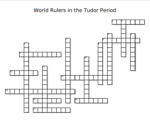
How much do you know about other rulers of the 15th and 16th centuries?
Test your knowledge of the other world leaders of the Tudor period in this week’s quiz – a crossword puzzle.
Simply click on the link or image below to open and print out.
[Read More...]
On this day in Tudor history, 26th February 1552, Sir Thomas Arundell, Sir Michael Stanhope, Sir Miles Partridge and Sir Ralph Fane (or Vane) were executed.
The men had been condemned as traitors after being accused of conspiring with Edward Seymour, Duke of Somerset and former Lord Protector, against John Dudley, Duke of Northumberland, the new man in control of King Edward VI’s government.
Find out all about these men and how these loyal royal servants came to these sticky ends in this talk…
[Read More...]
Tudor Murders – what an interesting theme we have for you in this month’s magazine. Murder is always a gruesome but fascinating topic and this magazine doesn’t disappoint
[Read More...]
On this day in Tudor history, 25th February 1570, Pope Pius V issued the papal bull “Regnans in Excelsis”. This bull not only excommunicated Queen Elizabeth I, it also freed her Catholic subjects from their allegiance to her and called on the English people to disobey her orders, mandates and laws. It threatened excommunication for those who did obey her.
It put Elizabeth I in danger and it put Catholics in an impossible situation.
Find out more about the bull and its impact in this talk…
[Read More...]
Sadly, our resident battlefield historian, Julian Humphrys, hasn’t been able to do any videos for us recently, so in case you’re suffering withdrawal symptoms, I thought I’d share a few of his past videos from our archives…
[Read More...]
On this day in Tudor history, 24th February 1603, Katherine Howard (née Carey), Countess of Nottingham, died at Arundel House.
Katherine was a close friend of Queen Elizabeth I and it is thought that grief over her friend’s death had a major impact on the queen’s own health, for she died just a month later.
Find out who Katherine was, how she rose to be the queen’s good friend, and also hear about a myth associated with her in this talk…
[Read More...]
On this day in Tudor history, 23rd February 1601, religious pamphleteer and Member of Parliament, Job Throckmorton, was buried at Haseley in Warwickshire.
Job was known for his alleged involvement in the “Marprelate Controversy”, a pamphlet war, and also for his colourful Parliamentary speeches, which nearly got him into trouble. He was lucky to escape imprisonment and worse!
Find out more about Job Throckmorton in this talk…
[Read More...]
On this day in Tudor history, 22nd February 1540, twenty-four-year-old Marie de Guise, or Mary of Guise, queen consort of King James V of Scotland, was crowned queen at Holyrood Abbey.
Did you know that Henry VIII was keen on making Marie de Guise his fourth wife? She declined, saying that her neck was small! Instead, she married James V.
Marie was, of course, the mother of Mary, Queen of Scots, and you can find out more about her in this talk…
[Read More...]
On this day in Tudor history, 21st February 1590, Ambrose Dudley, 3rd Earl of Warwick, Master of the Ordnance and Privy Councillor, died at Bedford House on the Strand.
Ambrose had been a loyal royal servant and was a member of that famous Tudor family, the Dudleys, with his father being John Dudley, Duke of Northumberland, and his brother being Robert Dudley, Earl of Leicester.
Find out more about Ambrose Dudley’s life and career in this talk…
[Read More...]
On this day in Tudor history, 20th February 1523, Agnes, or Alice, Lady Hungerford, was hanged at Tyburn.
Agnes was said to have “procured” her servants to murder her first husband, John Cotell, who was strangled before being thrown into the furnace of Castle Farley. A dastardly deed.
Find out exactly what happened in this talk…
[Read More...]