
YOUR SEARCH UNCOVERED 2372 RESULTS
-
A Tudor Funeral
-
13 April 1630 – The priest harbouring countess
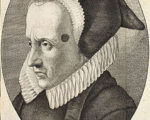
On this day in Tudor history, 13th April 1630, Anne Howard (née Dacre), Countess of Arundel, died at Shifnal.
Anne was the eldest daughter of Thomas Dacre, 4th Lord Dacre of Gilsand, and wife of Philip Howard, 13th Earl of Arundel, but there are some other interesting facts about this Tudor lady.
Find out more about this Countess of Arundel…
[Read More...] -
These Tudors Are Your Favourites
-
Artists in the Spotlight – Roland
-
Celebrate spring with the two Catherine’s
-
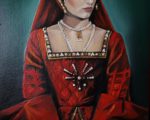
Artists in the spotlight – Siouxsie
-
Artists in the Spotlight – Erica

-
International Women’s Day – unknown Tudor women

-
A mathematician, Call Me Risley, and a scapegoat
In this second part of This week in Tudor history, historian Claire Ridgway introduces mathematician and inventor William Oughtred, tells you about the life of Thomas Wriothesley, the man known as “Call me Risley” in Hilary Mantel’s novels, and shares about Germaine Gardiner, a bishop’s nephew who was executed as a scapegoat.
5th March 1575 – Baptism of mathematician William Oughtred at Eton College. Oughtred is responsible for developing a straight slide-rule, a gauging rod and various sundials. He also introduced the “×” symbol for multiplication and the abbreviations “sin” and “cos” for the sine and cosine functions…
[Read More...] -
Tudor Fabrics
-
A Grand Prior, Anne of Denmark, Margaret Tudor’s third marriage and Mary Boleyn’s son
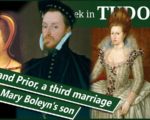
In the first part of her “This week in Tudor history” for week beginning 1st March, I introduce you to Thomas Tresham, grand prior of the Order of St John of Jersualem, and Anne of Denmark, James I’s queen consort, as well as talking about another unhappy marriage for Margaret Tudor, and the birth of Mary Boleyn’s son.
1st March 1559 – Death of Thomas Tresham, landowner, Catholic politician and Grand Prior of the Order of St John of Jerusalem in England.
[Read More...] -
Artists in the spotlight!

-
Broken leg kills translator, Elizabeth of York’s funeral, and an earl implicated in murder

In the first part of This Week in Tudor history for the week beginning 22nd February, historian and author Claire Ridgway talks about a translator killed by a broken leg, the lavish funeral of Elizabeth of York, and an earl who rose in the reigns of Elizabeth I and James I, but who was implicated in a murder in his final days.
22nd February 1571, in the reign of Queen Elizabeth I – The death of translator John Bury after breaking his leg in a fall from his horse….
[Read More...] -
Your Tudor Dream Team

A big thank you to Lorna Wanstall for inspiring this week’s Friday video with her idea about casting our Tudor dream team or dream cast. I’m looking forward to reading your ideas!
[Read More...] -
The Life of Anne Boleyn course discount
As it’s the 12th birthday of the Anne Boleyn Files website, the blog that started Claire’s career researching and writing, Claire is offering 25% discount code for her online course The Life of Anne Boleyn.
[Read More...] -
The Tudor Puzzle Book

I know that many of you enjoy our weekly Tudor crossword puzzles and word searches, so you’ll be interested to know that I’ve collated some of them, plus some new ones, in a paperback book.
I did intend to get the book out in time for Christmas, but with one thing and another it just didn’t happen. Oh well, better late than never! It’s available right now. Here are the details…
[Read More...] -
This week in Tudor history Part 1 – An alchemist, the Princes in the Tower’s doctor, and a duke who suffered a rigged trial
In this first part of “This week in Tudor history”, I look at Tudor history events for 1st, 2nd and 3rd February.
1st February 1552, in the reign of King Edward VI – The birth of Roger Cooke, an alchemist who worked for Dr John Dee, Francis Anthony, the Wizard Earl (Henry Percy, 9th Earl of Northumberland) and Sir Walter Ralegh, and a man with whom Dee shared the secret of a special elixir…
[Read More...] -
This Week in Tudor History Part 2 – Elizabeth I’s guardian, a Master of Swans, a king’s death announced and more!
In the second part of “This Week in Tudor History” for 25-31 January, I talk about events that happened on 28th, 29th, 30th and 31st January in the reigns of the Tudor monarchs. Find out more about the following Tudor people and events.
28th January 1501 – The death of politician and administrator, John Dynham, 1st Baron Dynham, who managed to move smoothly from service to the Yorkists to Henry VII’s service, and who survived the falls of his brother-in-law and stepson.
29th January 1559 – The death of Sir Thomas Pope, guardian of Princess Elizabeth (Elizabeth I), founder of Trinity College…
[Read More...] -
This week in Tudor History – 18-24 January – Part 1
Part 1 of “This week in Tudor History” covers Tudor history events from 18th to 21st January.
Find out all about these Tudor events…
[Read More...] -
This week in Tudor History – 11 – 17 January – Part 2
This second part of this week’s “This week in Tudor History” covers events that took place in the Tudor period on 14th, 15th, 16th and 17th January. Find out all about these Tudor events
[Read More...] -
Off with her head – A History Channel Podcast including an interview with Claire

Just before Christmas I recorded an interview with the History Channel podcast team, which was fun to do as it’s always lovely to talk about Tudor history, and especially Anne Boleyn.
If you’re in an English speaking country, you should be able to find the podcast on your usual podcast platform. Here’s the blurb and a few links for you:
[Read More...] -
John Neville, 4th Baron Latimer (1520-1577)
John Neville, 4th Baron Latimer, was born in around 1520 and was the only son of John Neville, 3rd Baron Latimer and his first wife, Dorothy de Vere. After his first wife’s death, the 3rd Baron married Elizabeth Musgrave; however, she also sadly died. In 1534, the 3rd Baron Latimer ¡married Katherine Parr, who was at that time Lady Borough, widow of Sir Edward Borough. This made John Neville the Younger the stepson of Katherine Parr.
It is said that Katherine was a kind stepmother to John and his sister, Margaret, evidenced by the latter’s will dated 1545, which thanked Katherine for her education and the kindness and love she had received when younger.
[Read More...] -
This week in Tudor History January 4 – 10
In this new series for 2021, I’m looking at Tudor events a week at a time. This talk covers events from the Tudor period which took place on January 4th, 5th, 6th, 7th, 8th, 9th and 10th.
[Read More...] -
January 2021 – Tudor Life – Lust
Happy new year! 2021 will undoubtedly be a better year than 2020… and to start you off, here’s the JANUARY magazine on the subject of lust …
[Read More...] -
30 December – An outlaw scholar from Spain who died of the plague
On this day in Tudor history, 30th December 1552, in the reign of King Edward VI, Spanish humanist scholar, translator, author and Protestant apologist, Francisco de Enzinas died at Strasbourg from the plague. He was buried there the next day. Humanist Francisco had changed his name to Francis Dryander after leaving Spain to study at Louvain.
Dryander fit a lot into his thirty-four years of life. He escaped from prison and was an outlaw, he translated the Bible, he taught Greek in England, he was supported by Archbishop Cranmer and the Duchess of Suffolk, and published several works.
Find out more about the accomplished Francis Dryander in today’s talk.
[Read More...] -
27 December – Katherine Killigrew, “the Muses friend, and saint of Heav’n”
On this day in Tudor history, 27th December 1583, scholar and Puritan Katherine Killigrew died after giving birth to a stillborn child.
Katherine was the daughter of renowned humanist and scholar, Sir Anthony Cooke, and was known for her ability at writing poetry and her knowledge of languages, including Hebrew, Latin and Greek. She was a very accomplished Tudor lady.
Find out more about Katherine, and hear the epitaphs that were written in her honour, in today’s talk.
[Read More...] -
26 December – The interesting life of Rose Lok
On this day in Tudor history, 26th December 1526, Protestant Rose Lok was born.
Rose lived well into her 80s and had an interesting life, being a Protestant exile, a businesswoman, and being the daughter of a man who supplied Anne Boleyn with religious books. She also had a ship named after her!
Find out all about Rose Lok in today’s talk.
[Read More...] -
25 December – A Tudor witch-hunter
Happy Christmas!
On this day in Tudor history, 25th December 1587, Brian Darcy, magistrate, Sheriff of Essex, witch-hunter and contributor to the 1582 “A true and just recorde of the information, examination and confession of all the witches, taken at S Oses [St Osyth]”, died.
“A True and Just Recorde” argued for harsher punishments for those found guilty of witchcraft, and Darcy was personally responsible for a number of deaths of people accused of witchcraft.
Find out more about this zealous witch-hunter in today’s talk.
[Read More...] -
24 December – A man who swapped sides at the right time
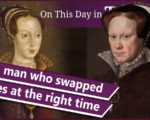
On this day in history, 24th December 1604, Christmas Eve, Sir Thomas Cornwallis, Comptroller of the household of Mary I and member of Parliament, died at about the age of eighty-six.
Cornwallis had been active putting down rebellion in 1549 and during the succession crisis of July 1553 swapped sides at just the right time, recanting his proclamation for Jane as queen and proclaiming for Mary instead, He was rewarded for this when Mary came to the throne.
Of course, he wasn’t so much a favourite in the reign of Elizabeth I, but a friendship with a man close to Elizabeth may have helped him escape trouble.
Find out more about Sir Thomas Cornwallis in today’s talk.
[Read More...] -
22 December – Two Protestants betrayed by a spy

On this day in Tudor history, 22nd December 1557, Protestant martyrs John Rough and Margaret Mearing, were burnt at Smithfield for heresy.
John Rough was a Scot who’d encouraged John Knox to be a pastor, but ended in days in England. Interestingly, the woman he died with was a woman he’d excommunicated from his congregation, believing her to be a spy. Although she’d been angry with her treatment, she was not the spy who betrayed him, she visited Rough in prison and was arrested after she tried to confront the real spy.
Find out about John Rough’s life and what brought him to England, how he’d come to be arrested, and what happened with Margaret Mearing, in today’s talk.
[Read More...]