On this day in history events for 23-29 May.
[Read More...]
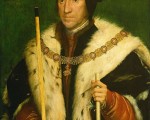
Thomas Howard was the eldest son of Thomas Howard, 2nd Duke of Norfolk, and of Elizabeth Tilney. He was the brother of Elizabeth Boleyn (née Howard) and Edmund Howard so was uncle to Queens Anne Boleyn and Catherine Howard. Howard’s father and grandfather had fought on Richard III’s side at the Battle of Bosworth but Howard was able to work his way back into royal favour by fighting for the Crown against both the Cornish rebels and the Scots in 1497. He was made a Knight of the Garter in 1510, was created Earl of Surrey in 1514 and succeeded his father as Duke of Norfolk in 1524. In September 1514 he was prominent in leading the English army in defeating the Scots at the Battle of Flodden.
[Read More...]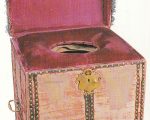
The Groom of the Stool, or, as the official title was known, The Groom of the King’s Close Stool, has gone down in history as one of the grossest jobs available. As the name suggests the Groom of the Stool was responsible for attending to the King’s toileting needs. The Groom would care for the King’s toilet, known in the Tudor period as a ‘Stool’. He would be responsible for supplying water, towels and a washbowl for the King when he had finished his business. There is some debate as to whether or not the Groom of the Stool was responsible for wiping the King’s behind, with some believing he did and others thinking his duties did not extend to that extreme.
While being responsible for the King’s bodily functions may seem quite disgusting for us in today’s times when going to the bathroom is considered to be a private matter, it was very, very different in the Tudor age.
The Huguenots were French Protestants, formed as a part of the general Reformation that started in Germany because of Martin Luther and swept through the Continent. It hit France around 1517, where the movement quickly grew in popularity. The movement was particularly popular in French areas where the population was unhappy with the government or areas that were experiencing economic hardship. The name “Huguenot” is of uncertain origin; some believe the Huguenots are named after Besançon Hugues, leader of the movement in Geneva, Switzerland. Another possibility finds its roots in the German word Eidgenossen, meaning confederates bound by oath, which became aignos in France and referred to patriots living in Geneva who were against the Duke of Savoy during 1520 to 1524. In August 1523, the first martyr, Jean Vallière, was burnt at the stake.
[Read More...]
On 30th March 1558, Queen Mary I made her last will and testament, believing that she would soon give birth and knowing that childbirth was a risky process.
[Read More...]
Today is the anniversary of Thomas Cranmer’s execution on 21st March 1556, when he was burned at the stake in Oxford for heresy. Here is a list of articles from the Tudor Society and the Anne Boleyn Files about this Oxford Martyr.
[Read More...]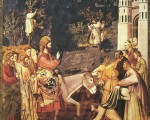
Palm Sunday is the sixth Sunday in Lent and marks the start of Holy Week. It commemorates the triumphal entry of Jesus Christ into Jerusalem on a donkey the week before the Resurrection. It is an event which features in the Gospels of Matthew, Mark, Luke and John, and here it is from John:
[Read More...]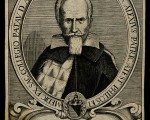
On 17th March 1565, Alexander Ales (also known as Alesius and Aless), theologian and reformer, died in Edinburgh, Scotland.*
Alexander Ales was born Alexander Allane or Alan at Edinburgh on 23 April 1500. From the age of twelve he was educated at the University of St Andrews, at St Leonard’s College, graduating BA after three years there. Ales became friends with theologian Philip Melancthon in 1532 when Ales began studying at Wittenberg University, and he began to be concerned with making the Bible available in the vernacular. He published an open letter to James V of Scotland in 1533, Alexandri Alesii epistola contra decretum quoddam episcoporum in Scotia, appealing for him to annul recent legislation making it illegal to own or distribute the New Testament in the vernacular. When the Catholic Johannes Cochlaeus, countered this with a letter to James accusing Ales of translating the New testament and sending it to Scotland, and claiming that it would cause unrest, Ales answered with Alexandri Alesii Scotti responsio ad Cochlei calumnias. In this letter, Ales emphasised how Continental reformers were simply trying to lead people back to the Bible and the teaching of the Early Church.
[Read More...]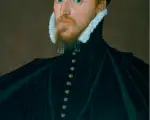
On 4th March 1526, Mary Boleyn gave birth to a son she named Henry Carey. Mary Boleyn was a member of Henry VIII’s court, was married to courtier William Carey and was also the older sister of Anne Boleyn, who would become Queen of England. I believe that Mary Boleyn was also the mistress of Henry VIII from around 1522 – 1525.
Over the centuries, there has always been a great deal of debate as to who Henry Carey’s father was. Henry Carey was conceived during 1525, the year, I believe, that Mary’s relationship with Henry VIII was coming to an end. It may be possible that during the last few times the King slept with Mary she conceived. It has also been suggested that Henry would not have wished to share Mary with her husband, keeping her to himself during the entire period of their relationship.
[Read More...]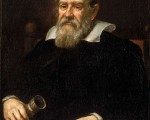
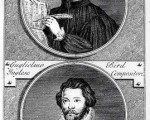
It is thought that Thomas Tallis, alternatively spelled “Tallys,” could have been born on 30 January 1505, though it is not known for certain. What is known is that Tallis did not die until 1585, and that he contributed greatly to the development and composition of English choral music. Not much is known about Tallis’s early life. There are no records of his education or really of his whereabouts until Tallis is well into his 20s. There is also no contemporary portrait of him, with the only existing portrait having been executed sometime after his death.
[Read More...]