The Tudor Society
  • 30 July 1588 – The wind scatters the Armada

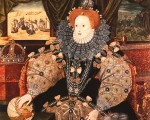
    Armada Portrait

    On 30th July 1588, the day after the Battle of Gravelines and the defeat of the Spanish Armada, the wind changed and the remaining ships of the Spanish Armada were forced northwards and scattered. It really did seem that the elements, particularly the wind, were on England’s side. Sir Francis Drake wrote to Sir Francis Walsingham on 30th July 1588, saying “There was never anything pleased me better than seeing the enemy flying with a southerly wind northward. We have the Spaniards before us, and the mind, with the grace of God, to wrestle a pull with them.”

    [Read More...]
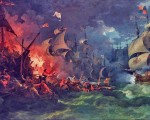
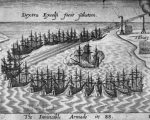
  • 29 July 1588 – The Battle of Gravelines between England and Spain

    In 1588, the day after the English had wrecked the crescent formation of the Spanish Armada and caused havoc, they attacked the Spanish fleet. This battle is known as the Battle of Gravelines because it took place just off the port of Gravelines, a Spanish stronghold in Flanders.

    [Read More...]
  • 28 July 1588 – The hell-burners

    At midnight on 28th July 1588, five hell-burners were ordered to be sent amongst the galleons of the Spanish Armada at Calais. Hell-burners were fire-ships, ships that were packed with wood and pitch and set alight. The high winds at Calais caused an inferno which resulted in complete chaos and the Armada’s crescent formation was wrecked as galleons scattered in panic.

    [Read More...]
  • 27 July 1588 – Leicester invites Elizabeth I to Tilbury

    On this day in history, the 27th July 1588, Robert Dudley, the Earl of Leicester and the Lieutenant and Captain General of the Queen’s Armies and Companies, invited Elizabeth I to visit Tilbury, where he was busy assembling troops. If you read my post from yesterday, you will know that 4,000 men had been assembled at Tilbury Fort on 26th July 1588 to guard the eastern approach to London from the expected invasion by the Spanish Armada.

    [Read More...]
  • 26 July 1588 – 4,000 men assemble at Tilbury Fort

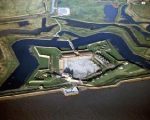
    On this day in history, the 26th July 1588, 4,000 men assembled at Tilbury Fort, the fort built on the Thames estuary in Essex by Elizabeth’s father, Henry VIII, to guard the eastern approach to London from the expected invasion by the Spanish Armada.

    [Read More...]
  • 20 August 1588 – A Thanksgiving Service for the Armada Victory

    Armada Portrait

    On 20th August 1588 a thanksgiving service was held at St Paul’s in London to give thanks to God for England’s victory over the Spanish Armada. The Armada had been defeated, obliterated in fact, yet the English fleet was left intact and only around 100 English men were lost in the skirmishes.

    [Read More...]
  • 9 August 1588 – Elizabeth I’s Tilbury Speech

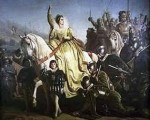
    On the 9th August 1588, Elizabeth I appeared before the troops that had gathered at Tilbury Fort in anticipation of a Spanish attack.

    In her article “The Myth of Elizabeth at Tilbury”, Susan Frye, writes that there are no reliable eye-witness accounts regarding Elizabeth I’s appearance on that day, but that tradition places the Queen in armour, giving a rousing speech – an iconic Gloriana.

    [Read More...]
  • 29 July 1588 – The Battle of Gravelines

    Defeat of the Spanish Armada at Gravelines, Philipp Jakob Loutherbourg the Younger.

    Defeat of the Spanish Armada at Gravelines, Philipp Jakob Loutherbourg the Younger.

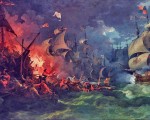
    On 29th July 1588, the day after the English had wrecked the crescent formation of the Spanish Armada at Calais with five hell-burners (fire-ships)and caused havoc, they attacked the Spanish fleet. This battle is known as the Battle of Gravelines because it took place just off the port of Gravelines, a Spanish stronghold in Flanders, part of the Spanish Netherlands, but near the border with France. The Duke of Medina Sedonia had been unable to reform the Spanish fleet at Calais, due to a south-easterly wind, and was forced to regroup at Gravelines.

    The English had learned from previous encounters with the Spanish fleet and so used new and more successful tactics. They had learned from capturing the Rosario in the Channel that the Spaniards could not easily reload their guns, so with their smaller and lighter ships the English were able to provoke the Spaniards into firing, but keep out of range and then close in for the kill.

    [Read More...]