With the end of the month nearing, it is time again to look back at what happened in the past few weeks. From a new discovery to History For Ukraine, March had a lot to offer.

With the end of the month nearing, it is time again to look back at what happened in the past few weeks. From a new discovery to History For Ukraine, March had a lot to offer.

On this day in Tudor history, 23rd March 1540, Waltham Abbey, an Augustinian house in Essex, was surrendered to the Crown.
It was the last abbey to be dissolved in Henry VIII and Thomas Cromwell’s dissolution of the monasteries.
Find out more about this historic abbey, its origins and what’s left today, and also who profited from its lands, in this talk…
[Read More...]
On this day in Tudor history, 17th March 1565, Scottish theologian and Reformer Alexander Alesius (also known as Ales, Aless), died in either Leipzig or Edinburgh.
Alesius wrote a huge number of theological works, was friends with reformers Philip Melancthon and Thomas Cranmer, Archbishop of Canterbury, but had a row with the Bishop of London at one point.
Find out more about Alexander Alesius and his terrifying vision or nightmare he experienced in the early hours of 19th May 1536, the day of Queen Anne Boleyn’s execution in this talk…
[Read More...]
On this day in history, 4th March 1609, Tudor spelling reformer and grammarian William Bullokar died at Chichester in West Sussex.
William Bullokar is known for writing the first grammar book of English, the “Pamphlet for Grammar”, and for his work reforming the alphabet to improve literacy.
Find out more about him and what he did in this talk…
[Read More...]
On this day in Tudor history, 29th January 1536, the same day that Catherine of Aragon was buried at Peterborough Abbey, Queen Anne Boleyn, second wife of King Henry VIII suffered a miscarriage.
Contemporary accounts state that she was around 3 1/2 months pregnant and that it was a boy.
In this talk, I share information given by the imperial ambassador on Anne Boleyn’s miscarriage, including the gossip concerning the king and a certain Jane Seymour.
[Read More...]
At the end of last year we started something new on the website: a blog. Each month we will look back on exciting discoveries, new books, exhibitions, and lots more. In addition to that, we will mention what you may have missed on the Tudor Society website and look ahead to upcoming events. Today’s blog focuses on the first month of 2022!
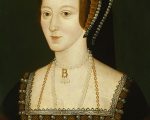
Recently, as part of the launch for my “Anne Boleyn, the Woman who changed England” online event (28th February to 6 March 2022), I did three livestreams about Anne Boleyn.
If you didn’t manage to catch them live, here they are, plus the extra I did about my January masterclass, which is a bonus if you buy your tickets before 31st December.
[Read More...]
From books to exhibitions, to new discoveries and more. Every month we (Merel and Emma) will give you an update on all things new and exciting in the Tudor world. Starting with the first blog in which we look back on what has happened in November.
On this day in Tudor history, 28th October 1570, Ivan IV of Russia, known commonly as Ivan the Terrible, wrote a rather rude letter to Queen Elizabeth I.
Ivan was upset with Elizabeth’s reaction to his idea of a political alliance, an agreement to help each other if their lives were in danger, and wrote the letter while he was still angry. They were words that must have made Elizabeth see red for a while, but she managed to write a calm reply to him.
Find out exactly what Ivan the Terrible and Elizabeth I wrote to each other, and how they came to be corresponding in the first place, in this talk…
[Read More...]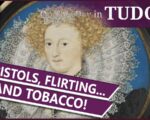
On this day in Tudor history, 27th October 1561, Mary Herbert (née Sidney), Countess of Pembroke, writer and literary patron, was born at Tickenhall, near Bewdley in Worcestershire. She was the sister of the poets Sir Philip Sidney and Robert Sidney, Earl of Leicester, was a writer herself and an extremely talented lady, and she also lived life to the full.
After her husband died, she had fun shooting pistols, flirting, taking tobacco and dancing. A fun lady!
Find out more about this gifted Tudor woman, who was as beautiful as she was talented, and whose work was praised, and used, by men such as Shakespeare.
[Read More...]Today, 25th October, is a feast day which was celebrated in medieval and Tudor times – the feast of Saints Crispin and Crispinian, martyrs of the Early Church and the patron saints of cobblers.
Find out more about these saints, how their feast day became linked to an important English victory over the French, how it was marked, and why these saints are linked to Faversham in Kent, in this talk…
[Read More...]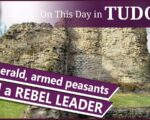
On this day in Tudor history, 21st October 1536, during the Pilgrimage of Grace rebellion, Lancaster Herald had an encounter with armed peasants on his way to Pontefract Castle and then met with the rebel leader, Robert Aske, at the castle.
The meeting didn’t go well, with Aske putting his foot down and not allowing the herald to complete his mission.
What was going on? Who was Lancaster Herald? What was his mission?
[Read More...]
On this day in Tudor history, 16th October 1532, while Henry VIII and Anne Boleyn, Marquess of Pembroke, were on their visit to Calais, English nobles met French nobles to arrange a meeting between the King of England and his French counterpart, King Francis I.
In this video, I give details on this event, who was there, what happened, and why Henry VIII and Anne Boleyn had gone to Calais…
[Read More...]
On this day in Tudor history, 11th October 1532, King Henry VIII and Anne Boleyn, the newly created Marquess of Pembroke, set sail from Dover aboard the king’s ship, The Swallow.
They were off to Calais on a mission involving the Great Matter, Henry VIII’s quest for an annulment. But why? What would they do there? Who would they meet?
Find out more about this trip, what happened and what happened next…
[Read More...]
On this day in Tudor history, 1st September 1566, Edward Alleyn, a major figure in the Elizabethan theatre, was born in the parish of St Botolph without Bishopsgate, London, and baptised the following day.
In this video, I share some facts about Edward Alleyn, including his personal life, the plays he was involved in, his theatre investments, and his desire to be appointed master of the bears, bulls and mastiff dogs!
[Read More...]
On this day in Tudor history, 26th August 1555, Queen Mary I and her husband, Philip of Spain, departed from Whitehall in preparation for Philip’s return to the Low Countries.
This was an awful time for Mary I. She had just come out of confinement after months of believing she was pregnant, and now her husband was leaving her. He’d be gone for over 18 months.
Find out more about Mary’s state of health and mind, the arrangements for Philip’s departure, and Mary’s reaction…
[Read More...]
After many clips and images surfaced on social media over the past few months, the new Anne Boleyn series is finally here. It is a fresh take on the story we have read and seen so many times, focussing on the final five months of the queen’s life.
As it’s coming up to the anniversary of the coronation of Anne Boleyn, Henry VIII’s second wife, I thought we’d mark the occasion with an Anne Boleyn coronation quiz.
How much do you know about Anne Boleyn’s coronation celebrations and ceremony?
Test yourself with this fun quiz.
[Read More...]
On this day in Tudor history, 29th May 1533, the citizens of London were treated to a spectacular river procession. It was part of the coronation celebrations for England’s new queen, Anne Boleyn.
[Read More...]
On 28th May 1533, over four months after Henry VIII had married Anne Boleyn at Whitehall, and six months after a possible secret marriage at Dover, Archbishop Cranmer proclaimed the union valid.
Anne was now officially queen and it was just in time for her coronation!
[Read More...]
Thank you so much to Kate McCaffrey for sharing this guest article with us today. Kate has been in the news recently because of her discovery of previously hidden inscriptions in one of Anne Boleyn’s Books of Hours at Hever Castle – a wonderful discovery.
Do follow the link at the end of this post to read Kate’s guest article on the Anne Boleyn Files too.
Over to Kate…
Catherine of Aragon and Anne Boleyn. Two queens, two wives, two rivals. They are both highly recognisable leading women from sixteenth-century England, but are also famed rivals in love and power. At best, we consider them to have had a fraught, divisive relationship. In today’s society, as is so often the case, we frequently see them as two women pitted against each other: one ‘good’, one ‘bad’, one Catholic, one Reformist, one wife, one mistress. Certainly, they were rivals and had many differing opinions and standpoints, but they also had key qualities in common. They were both highly educated, pious women who were at the whims of their changeable husband and who, in their own ways, were victims of patriarchal circumstance.
[Read More...]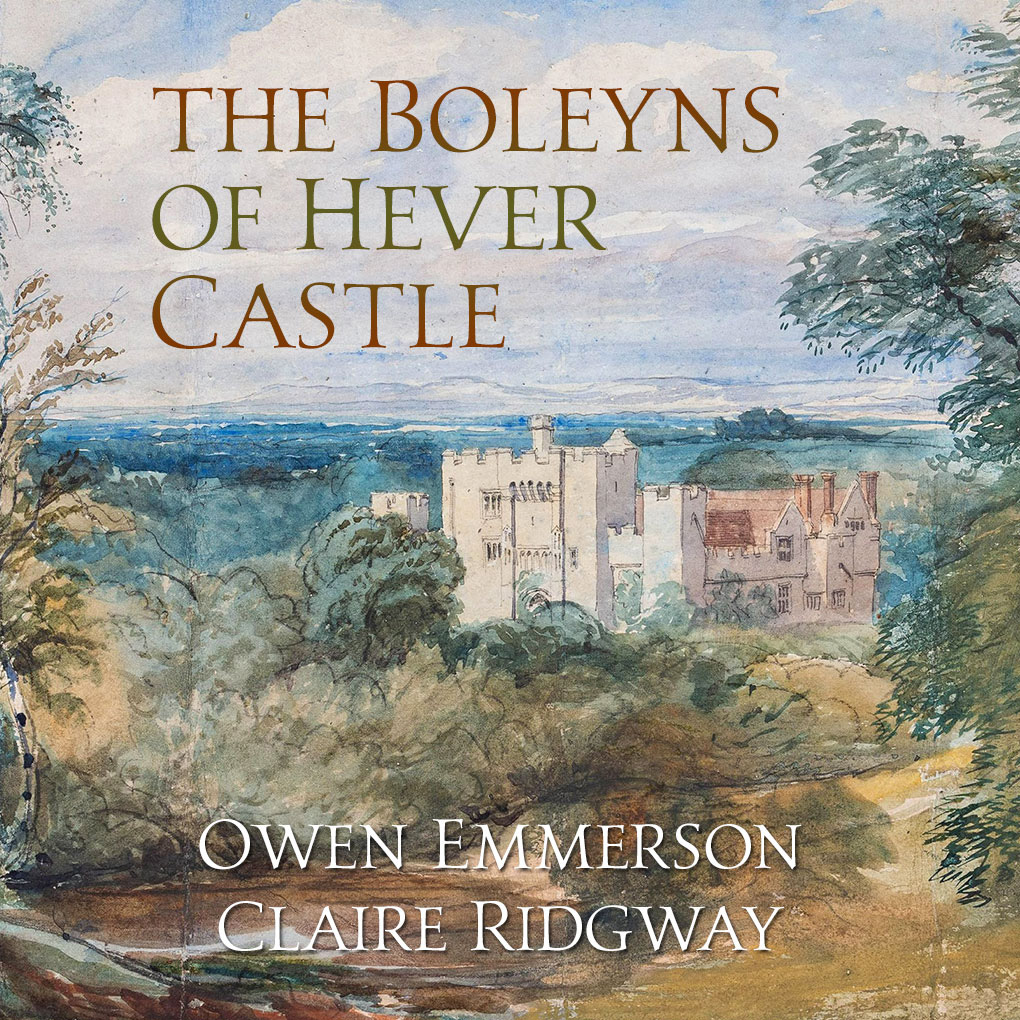
The 19th May, the anniversary of Queen Anne Boleyn’s execution, seems a fitting day to announce some news regarding a Boleyn-themed book, don’t you think?
Many of you will know that Dr Owen Emmerson and I have been working on a book about the history of Hever Castle, the childhood home of Anne Boleyn. Well, the original book idea had to be postponed due to travel restrictions and the closure of archives, so we decided to focus on 77 years of Hever’s history, the time when it was owned by the Boleyn family.
The Boleyns of Hever Castle will be launched at Hever Castle on 1st August 2021 – hurrah!
[Read More...]
On 13th May 1536, eleven days after her arrest, the royal household of Queen Anne Boleyn was broken up and her household discharged.
The queen hadn’t even been tried yet, never mind found guilty!
Find out more about this day and what happened to members of her household in this #TudorHistoryShorts video…
[Read More...]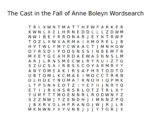
May is the anniversary month of the events leading up to the execution of Queen Anne Boleyn on 19th May 1536. Things moved so quickly that spring!
But how much do you know about the cast of Anne Boleyn’s fall – the people who were involved, either as victims or on the side of the Crown?
Test yourself on the people caught up in the events of May 1536 with this fun word search puzzle.
[Read More...]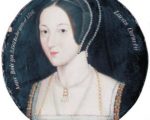
On this day in Tudor history, 2nd May 1536, in the reign of King Henry VIII, the king’s second wife, Anne Boleyn, was arrested. What happened on that day? What was she told? Where was she taken?
Find out in this #TudorHistoryShorts video…
[Read More...]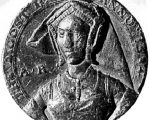
Our May expert speaker is stonecarver Lucy Churchill who has done extensive research on two Anne Boleyn-related items – the 1534 medal, which she has reconstructed, and the choirscreen of King’s College Chapel, Cambridge.
[Read More...]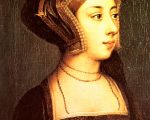
I’ve gone back to doing “on this day” videos as I know people enjoy daily videos. The new ones, however, are YouTube Shorts, so under a minute long, just to give key interesting facts. If I’ve done a longer video in the past then I will share those too. Doing these shorts just gives me more time to create longer videos on Tudor topics.
On this day in Tudor history, 12th April 1533, Anne Boleyn’s behaviour caused a stir and Eustace Chapuys, the imperial ambassador, was outraged. He didn’t know she was actually queen. In his eyes, there was one queen: Catherine of Aragon.
[Read More...]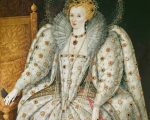
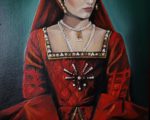
A couple of weeks ago we asked our Instagram followers to vote on their favourite Tudor Monarch and wife of Henry VIII. We combined the votes with the most searched questions on Google and the country in which they are most popular. Here are the results!

Those of you who are in the UK or planning on visiting the UK this summer (fingers crossed!) many be interested in knowing that I will be speaking with my dear friend, Hever Castle Supervisor Dr Owen Emmerson, at Hever Castle on Sunday 1st August 2021.
The talk is on our very favourite subject, the Boleyns, and it will take place at the Two Sisters Theatre in the grounds of Hever Castle at 8pm.
Anne Boleyn’s parents weren’t the only Boleyns linked to the castle, it was connected to the Boleyn family for 77 years before it was taken by the Crown, and we’ll tell you all about its Boleyn owners.
[Read More...]