The Tudor Society

YOUR SEARCH UNCOVERED 2372 RESULTS

  • 5 June – Maria de Salinas, Catherine of Aragon’s friend

    On this day in Tudor history, 5th June 1516, Spaniard Maria de Salinas married William, 10th Lord Willoughby of Eresby.

    Maria and William were the parents of Catherine Willoughby, who went on to marry Charles Brandon, Duke of Suffolk. Maria was also a good friend of Catherine of Aragon and managed to be with the queen in her final hours, even though she wasn’t supposed to be there.

    Find out more about Maria de Salinas in today’s talk.

    [Read More...]
  • 4 June – Lightning strikes St Paul’s

    On the afternoon of this day in Tudor history, Wednesday 4th June 1561, in the reign of Queen Elizabeth I, London was hit by a tremendous thunderstorm. Fires caused by lightning strikes destroyed one church and damaged St Paul’s Cathedral.

    Find out more about the storm, how St Paul’s was damaged, the reactions to the lightning strike, what Queen Elizabeth I did, and what happened next, in today’s talk.

    [Read More...]
  • 1 June – Christopher Marlowe’s death and inquest

    On this day in Tudor history, 1st June 1593, the inquest into the death of playwright, poet and translator Christopher Marlowe took place.

    Twenty-nine-year-old Marlowe, writer of such famous works as “Tamburlaine”, “Dr Faustus” and “The Jew of Malta”, had been fatally stabbed at a house in Deptford Strand, London, by a man named Ingram Frizer on 30th May 1593, but what happened?

    In today’s “on this day” talk, I share William Danby’s coroner’s report on what happened that fateful day.

    [Read More...]
  • 30 May – Knights of the Bath for Anne Boleyn’s coronation

    On this day in Tudor history, on the night of 30th/31st May 1533, as part of the celebrations for Queen Anne Boleyn’s coronation, which was scheduled for 1st June, eighteen men were created Knights of the Bath.

    What did this mean? What happened in this night-long ceremony?

    Find out in today’s talk.

    [Read More...]
  • 27 May – Margaret Pole’s botched execution

    On this day in Tudor history, 27th May 1541, the frail sixty-seven-year-old Margaret Pole, Countess of Salisbury, was executed at the Tower of London.

    The former governess of Princess Mary had an awful end because the usual executioner was away from London, and one account has led to stories of her tormented ghost reliving her final moments at the Tower.

    Find out why Margaret Pole was executed and what happened in today’s talk.

    [Read More...]
  • 25 May – A great shaking of the ground – a Tudor earthquake

    On this day in Tudor history, 25th May 1551, at around noon, Croydon and several Surrey villages, in the south of England, experienced a “great shaking of the ground”, in other words, an earthquake.

    In today’s talk, I share descriptions of this earthquake, as well as other Tudor earthquakes, such as the famous 1580 Dover Straits Earthquake, which caused fatalities and damage.

    [Read More...]
  • 24 May – The Life of Anne Askew

    On this day in Tudor history, 24th May 1546, letters were sent from the Privy Council to the future Protestant martyr Anne Askew and her estranged husband Thomas Kyme.

    The couple were ordered to appear in front of the council within fourteen days. But why? What was going on? And what happened next.

    In today’s talk, I give an overview of the life of Anne Askew, who was famously racked illegally at the Tower of London prior to being burnt as a heretic.

    [Read More...]
  • 22 May – New Garter Knights

    On this day in Tudor history, 22nd May 1541, following their elections on St George’s Day, 23rd April 1541, Edward Seymour, Earl of Hertford; Henry Howard, Earl of Surrey; Sir John Gage, and Sir Anthony Wingfield were all installed as Knights of the Garter.

    Who were these men and what was the Order of the Garter?

    I introduce these Garter Knights and explain the origins of the Order of the Garter, England’s oldest order of chivalry, in this video:

    [Read More...]
  • Elizabeth Barton – The Holy Maid of Kent (1506-1534)

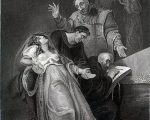
    An engraving of Elizabeth Barton swooning with a vision

    Little is known about the early life of Elizabeth Barton. We do not know anything about her childhood or her family; however, she probably received little to no formal education and was probably illiterate. She first enters the public eye aged 19, when she was working as a servant in the house of Thomas Cobb, the farm manager to Archbishop William Warham.

    While working as a servant, Barton became severely ill, during which time she claimed to receive divine inspiration. This ‘illness’ prevented Elizabeth from eating and drinking, and during her sickness, she began prophesying. She predicted that a sickly child would die, spoke about the ten commandments and the seven deadly sins, and saw visions of heaven. Her visions and prophecies began to gain traction in the local community. Eventually, the parish priest Richard Master travelled to Canterbury to inform Archbishop Warham of her seemingly holy abilities. Warham investigated Barton’s skills, and when questioned, she was found to be of a strong and orthodox faith. Following her interrogation, it is said that she predicted God would cure her illness in the village of Court-at-Street. In 1526, it was reported that she travelled there and was cured, in front of three thousand spectators. Barton also professed that it was divine will that she become a nun and that a monk named Father Bocking, who conducted her investigation, should be her spiritual advisor.

    [Read More...]

  • 20 May – A cardinal’s hat for a headless man

    On this day in Tudor history, 20th May 1535, Pope Paul III made John Fisher, Bishop of Rochester, Cardinal-Priest of San Vitale, and arranged to have his cardinal’s hat sent to him.

    The pope hoped that this would save Fisher, who was imprisoned at the time, from further punishment, but it made the king even more determined to behead Bishop Fisher. Oh dear!

    Find out more about what happened in today’s talk.

    [Read More...]
  • 18 May – Rebel William Thomas comes to a bad end

    On this day in Tudor history, 18th May 1554, in the reign of Queen Mary I, scholar and administrator, William Thomas, was hanged, drawn and quartered at Tyburn for his alleged involvement in Wyatt’s Rebellion. It was said that he even wanted the queen assassinated.

    But William Thomas was far more than a rebel, he was also the author of the first he first Italian dictionary and book of grammar to be published in English.

    Find out more about him and his rather bad end in today’s talk.

    [Read More...]
  • 17 May – Anthony Bacon, a Tudor spy

    On this day in Tudor history, 17th May 1601, Anthony Bacon was buried in St Olave’s, London.

    You might have heard of Francis Bacon, but his brother, Anthony Bacon, was rather interesting too!

    Who was Anthony Bacon?

    Well, he was a spy, providing intelligence for the likes of William Cecil, Sir Francis Walsingham, Elizabeth I and Robert Devereux, Earl of Essex. Find out more in today’s talk

    [Read More...]
  • 15 May – Two noblemen tried for treason

    On this day in Tudor history, 15th May 1537, Thomas Darcy, 1st Baron Darcy de Darcy, and his cousin, John Hussey, 1st Baron Hussey of Sleaford, were tried for treason at Westminster after being implicated in the Pilgrimage of Grace rebellion.

    Both men may have been sympathetic to the rebel cause, but there was no actual evidence that they conspired against the king. Poor men!

    Find out more about them and how they ended up being branded rebels, and what happened next, in today’s talk.

    [Read More...]
  • 13 May – A battle between Mary, Queen of Scots, and her half-brother

    On this day in Tudor history, 13th May 1568, the forces of Mary, Queen of Scots, met those of her brother, the Regent Moray, at the Battle of Langside in Scotland.

    Mary, Queen of Scots was defeated soundly, but what happened and why was she fighting against the regent acting on behalf of her son, King James VI? What had led to this moment.

    I explain all in today’s talk.

    [Read More...]
  • 12 May – A very obstinate friar

    On this day in Tudor history, 12th May 1538, a Franciscan friar obstinately refused to make a public recantation of his allegiance to Rome.

    Friar John Forest had been condemned for heresy and was meant to abjure his faith at St Paul’s Cross, but he decided not to. Find out more about what happened:

    [Read More...]

  • May 10 – A search for the Northeast Passage finds Ivan the Terrible instead

    On this day in Tudor history, 10th May 1553, near the end of King Edward VI’s reign, the first expedition of the Company of Merchant Adventurers, left London in search of a Northeast passage for Asia.

    The voyage, with its fleet of three ships, was led by Richard Chancellor, Sebastian Cabot and Sir Hugh Willoughby. It failed in its aim, and Willoughby and his crew died, but Richard Chancellor was able to come to a very beneficial agreement with Ivan the Terrible.

    Find out more about the company, the voyage and the resulting trade agreement, and Muscovy Company, in today’s talk.

    [Read More...]
  • 9 May – Colonist William Bradford

    On this day in history, in the Stuart period, 9th May 1657, William Bradford died. He is known as the founder of the Plymouth Colony in America and the writer of a chronicle of its early years: ““Of Plimmoth Plantation”.

    But how did a Yorkshire man of farming stock become a Puritan and a governor of a colony in North America? What led to him becoming a “pilgrim” and boarding The Mayflower?

    Find out in today’s talk.

    [Read More...]
  • Tudor Letters

    In this week’s Claire Chats video, I talk about Tudor letters and share two of Elizabeth I’s letters, one from her youth and another from the last weeks of her life. Below my talk, you can find links to books of letters and archives where you can read Tudor letters. Enjoy!

    [Read More...]
  • 6 May – Sir James Tyrell, alleged killer of the Princes in the Tower

    On this day in Tudor history, 6th May 1502, in the reign of King Henry VII, Sir James Tyrell, former royal councillor, was executed for treason due to his links to a known traitor.

    But it’s not for his time as a trusted councillor, or for his links to a claimant to the throne that he is known, but for his alleged involvement in the murders of the Princes in the Tower.

    Find out more in today’s talk.

    [Read More...]
  • 3 May – A man who served 3 monarchs and kept his head

    On this day in Tudor history, 3rd May 1568, courtier, member of Parliament, and privy councillor, Sir Edward Rogers, died.

    Rogers had a long and successful royal career, serving three of the Tudor monarchs, and he managed to keep his head too.

    Find out more about him, and how he even survived being implicated in rebellion and opposing Mary I, in today’s talk.

    [Read More...]
  • 2 May – Celestial flesh leads to a burning

    On this day in history, 2nd May 1550, Anabaptist Joan Bocher, was burnt to death at Smithfield for her belief in Christ’s celestial flesh.

    How did a Protestant end up being executed in Edward VI’s reign and what did she mean by Christ having celestial flesh?

    Find out more about Joan Bocher, or Joan of Kent, her beliefs and her links to Protestant martyr Anne Askew, in today’s talk.

    [Read More...]
  • 1 May – A hot-tempered Tudor courtier

    On this day in Tudor history, 1st May 1551, in the reign of King Edward VI, Norfolk landowner and Member of Parliament, Sir Edmund Knyvet, died.

    Knyvet had an interesting court career, being helped by his Howard connections, but he was known for his rather hot temper, which nearly led to him losing his right hand.

    Find out more about hot-tempered Sir Edmun Knyvet in today’s talk.

    [Read More...]
  • Tudor series and documentaries

    This lockdown is definitely easier when you immerse yourself in Tudor history, and so much better for you than raiding the fridge and cupboards!

    A few weeks ago, I shared some suggestions for Tudor movies and I thought it would also be good to share some recommendations for documentaries and non-fiction series. Please feel free to add your recommendations in the comments.

    [Read More...]
  • 29 April – Bothwell prepares to marry Mary, Queen of Scots

    On this day in Tudor history, 29th April 1567 (some sources suggest 26th), James Hepburn, Earl of Bothwell, who had recently abducted and allegedly “ravished” Mary, Queen of Scots, had a suit of divorce made against him by his wife, Lady Jean Gordon.

    Lady Gordon was persuaded by Bothwell to make this divorce suit as he was planning to marry Mary, Queen of Scots, which he did on 15th May 1567.

    In this talk, I explain what led up to this day, what happened next, and also what a truly horrible man Bothwell was.

    [Read More...]
  • 27 April – A Tudor and Stuart adventurer

    On this day in history, actually in the Stuart period, 27th April 1609, Sir Edward Michelborne, member of Parliament, soldier and adventurer, died.

    He’d survived an unsuccessful naval campaign against the Spanish, being implicated in a rebellion, and an attack by pirates, to die a natural death at his home in Hackney.

    Find out more about Sir Edward Michelborne in today’s talk.

    [Read More...]
  • 26 April – Shakespeare and the Plague

    On this day in Tudor history, 26th April 1564, the Bard, William Shakespeare, was baptised at Holy Trinity Church, Stratford-upon-Avon, Warwickshire. This was just three months before the plague hit the town, wiping out a fifth of its population. Fortunately for him, and us, Shakespeare didn’t catch it – phew!

    Find out more about the plague and its outbreak in Stratford-upon-Avon in today’s talk.

    [Read More...]
  • 24 April – Divining your future love

    Today, 24th April, is St Mark’s Eve, the day before the Feast of St Mark the Evangelist, one of Christ’s apostles and the man who is said to have written the Gospel of Mark. In medieval and Tudor times, St Mark’s Eve was the night to divine who you were going to marry.

    How did people go about divining their future partner?

    Find out in today’s talk and do let me know if you try any of these divination methods!

    [Read More...]
  • 23 April – George Boleyn loses out

    On this day in Tudor history, 23rd April 1536, St George’s Day, George Boleyn, Lord Rochford, lost to Nicholas Carew in the Order of the Garter elections.

    George Boleyn was, of course, the brother of Queen Anne Boleyn, so how did he lose, and was this a sign of the beginning of the end for the Boleyns?

    Find out what exactly happened in today’s talk.

    [Read More...]
  • 21 April – The Philosopher’s Stone offered to Elizabeth I

    On this day in Tudor history, 21st April 1581, alchemist Thomas Charnock was buried at Otterhampton in Somerset.

    Charnock was obsessed with alchemy and claimed to have made the philosopher’s stone, which he offered to Queen Elizabeth I in exchange for financial support.

    Find out more about Thomas Charnock, his work on alchemy, and the philosopher’s stone, in today’s talk.

    [Read More...]
  • 20 April – Lady Mary Grey, sister of Lady Jane Grey

    On this day in Tudor history, 20th April 1578, Lady Mary Keys (née Grey), sister of Lady Jane Grey and wife of Thomas Keys, died at her home in the parish of St Botolph without Aldgate, London.

    Like her sisters, Mary had a sad life. Her secret marriage led to Elizabeth I imprisoning her and her husband, and they never saw each other again.

    Find out more about the tiny Mary who was described as “crook-backed”, her marriage to a man who was said to be 6’8, and what happened to Mary and Thomas, in today’s talk.

    [Read More...]