The Tudor Society

YOUR SEARCH UNCOVERED 1673 RESULTS

  • Elizabeth Howard (née Stafford), Duchess of Norfolk (1497-1558)

    Elizabeth Stafford was born in 1497 and was the eldest daughter of Edward Stafford, 3rd Duke of Buckingham, and his wife, Eleanor, eldest daughter of Henry Percy, 4th Earl of Northumberland. Through her parents, Elizabeth was a descendant of King Edward III, and her paternal grandparents were Henry Stafford, 2nd Duke of Buckingham, and Lady Katherine Woodville, sister of Elizabeth Woodville. Her paternal grandfather was beheaded for treason against Richard III in 1483, which is a fate her father would suffer in 1521, beheaded for treason against Henry VIII.

    [Read More...]
  • This week in Tudor History Part 2 – A princess marries, a queen faces death, and a spy and lawyer die

    In this second part of “This week in Tudor history” for the week beginning 1st February, I talk about Tudor events and people associated with 4th, 5th, 6th and 7th February.

    4th February 1495, in the reign of King Henry VII – Anne of York, daughter of the late King Edward IV, marries Thomas Howard, Earl of Surrey, at Westminster Abbey in London…

    [Read More...]
  • This week in Tudor History – 18-24 January – Part 1

    Part 1 of “This week in Tudor History” covers Tudor history events from 18th to 21st January.

    Find out all about these Tudor events…

    [Read More...]
  • 27 December – Katherine Killigrew, “the Muses friend, and saint of Heav’n”

    On this day in Tudor history, 27th December 1583, scholar and Puritan Katherine Killigrew died after giving birth to a stillborn child.

    Katherine was the daughter of renowned humanist and scholar, Sir Anthony Cooke, and was known for her ability at writing poetry and her knowledge of languages, including Hebrew, Latin and Greek. She was a very accomplished Tudor lady.

    Find out more about Katherine, and hear the epitaphs that were written in her honour, in today’s talk.

    [Read More...]
  • 19 December – A conspirator found dead in his cell

    On this day in Tudor history, 19th December 1583, twenty-three-year-old convicted conspirator, John Somerville, was found dead in his cell at Newgate Prison. His death was said to be suicide, due to his poor mental health, but some Catholics believed that he had been killed.

    Somerville had been found guilty of conspiring to assassinate the queen, but did he really mean to? Was he mentally ill? Was he manipulated by others?

    Find out more about John Somerville in today’s talk.

    [Read More...]
  • 15 December – Elizabeth I’s loyal servant dies of “sheer grief”

    On this day in Tudor history, 15th December, 1560, Comptroller of the Household to Elizabeth I and Lord Lieutenant of Berkshire, Thomas Parry died. The Spanish ambassador claimed that Parry had died of “sheer grief”. He was buried at Westminster Abbey.

    Parry had served Elizabeth since 1547 and was a loyal servant and friend. So why did he die of grief?

    Find out more about Thomas Parry, his background, life, and why he was upset in 1560, in today’s talk.

    [Read More...]
  • 9 December – A scary time for Queen Catherine Howard’s stepgrandmother

    On this day in Tudor history, 9th December 1541, sixty-four-year-old Agnes Tilney, the Dowager Duchess of Norfolk and step-grandmother of Queen Catherine Howard, who was being detained at the Lord Chancellor’s home, was questioned regarding the location of her money and jewels.

    Why? What was all this about?

    Find out about this, why the dowager duchess ended up in the Tower, and what happened when she was indicted for misprision of treason, in today’s talk.

    [Read More...]
  • 5 December – Mary Queen of Scots’ husband dies of an ear infection

    On this day in Tudor history, 5th December 1560, King Francis II of France, died at the age of just 15. Francis was King Consort of Scotland, as the husband of Mary, Queen of Scots, and his father had also proclaimed him and Mary as King and Queen of England back in 1558!

    He was taken ill in mid-November with what appears to have been an ear infection, and it led to him dying on this day in history. His death led to Mary, Queen of Scots, returning to her homeland of Scotland, a country she hadn’t seen for 13 years.

    Find out more about Francis II of France, his marriage to Mary, Queen of Scots, his death and what happened next, in today’s talk.

    [Read More...]
  • 2 December – Elizabeth I relents and agrees to execute Mary, Queen of Scots

    On this day in Tudor history, 2nd December 1586, following a joint petition from the Houses of Lords and Commons, Elizabeth I finally agreed to a public proclamation of sentence against Mary, Queen of Scots: death.

    Mary had been found guilty of high treason back in October 1586, but Elizabeth had not wanted to contemplate regicide. However, Parliament believed that if Mary, Queen of Scots, was not executed, that she’d continue to plot against Elizabeth and would utterly “ruinate and overthrow the happy State and Common Weal of this most Noble Realm”. She was too much of a danger and needed dealing with once and for all.

    Find out what Parliament said and what happened next in today’s talk.

    [Read More...]
  • 30 November – Elizabeth I’s Golden Speech brings men to tears

    On this day in Tudor history, 30th November 1601, sixty-eight-year-old Queen Elizabeth I delivered her famous Golden Speech to the House of Commons.

    In this final speech to Parliament, Elizabeth spoke of her position as Queen and her love and respect for her realm, her people, and for her members of Parliament. It was a speech that brought many of those listening to tears. It was obviously a very heartfelt speech by a queen who truly loved her people.

    In today’s talk, I share Elizabeth I’s Golden Speech, along with some beautiful portraits of the queen.

    [Read More...]
  • 28 November – A drowned agent carrying gold for Mary, Queen of Scots

    On this day in Tudor history, 28th November 1565, member of Parliament and political agent Francis Yaxley set sail for Scotland from Antwerp. Sadly, Yaxley’s ship was wrecked in a storm and he never reached Scotland, and neither did the gold he was carrying to Mary, Queen of Scots.

    But why was he carrying gold and who was it from? What happened to the gold? Find out all about Yaxley, how he came to be travelling from Antwerp to Scotland, and what happened to him and the gold, in today’s talk.

    [Read More...]
  • 27 November – Former monk burnt at stake for importing books

    On this day in Tudor history, 27th November 1531, former Benedictine monk and reformist, Richard Bayfield, was burnt at the stake at Smithfield for heresy after Sir Thomas More had caught him importing heretical books into England.

    It wasn’t Bayfield’s first brush with the authorities. He’d been in trouble for heresy previously so was now deemed a “relapsed heretic”. This time, penance wasn’t enough, he was condemned to death.

    Find out more about Richard Bayfield, how he went from being a monk to a reformer, and how he ended up at the stake as a Protestant martyr. I also share John Foxe’s account of Bayfield’s burning.

    [Read More...]
  • 26 November – The first men executed under Elizabeth I’s new law

    On this day in Tudor history, 26th November 1585, Catholic priest Hugh Taylor and his friend Marmaduke Bowes were hanged at York.

    They were the first men executed under Elizabeth I’s 1585 statute which made it treason to be a Jesuit or seminary priest in England or to harbour such a priest.

    These two Catholics were beatified in 1987 by Pope John Paul II as two of the 85 Martyrs of England, Scotland and Wales.

    Find out more about these men and what this 1585 legislation was all about in today’s talk.

    [Read More...]
  • 23 November – A plot to poison Elizabeth I’s saddle and Essex’s chair

    On this day in Tudor history, 23rd November 1598, scrivener and sailor Edward Squire was hanged, drawn and quartered at Tyburn for treason after being accused of plotting with Jesuits in Seville to poison Elizabeth I’s saddle and the Earl of Essex’s chair.

    Squire, who ended up in Seville after being captured by Spaniards while on a voyage with Sir Francis Drake, confessed under torture, but claimed his innocence at his trial and execution.

    But what exactly happened, and how and why did a Protestant scrivener and sailor end up accused of treason?

    Find out all about Edward Squire and the alleged plot to assassinate Queen Elizabeth I and her favourite, Robert Devereux, 2nd Earl of Essex, in today’s talk.

    [Read More...]
  • 17 November – Elizabeth I’s accession

    On this day in Tudor history, 17th November 1558, twenty-five-year-old Elizabeth, daughter of King Henry VIII and Anne Boleyn, became Queen Elizabeth I following the death of her half-sister, Queen Mary I.

    In today’s talk, I look at an alternative account of Elizabeth I’s words on her accession, one recorded by her godson, Sir John Harington. Hear Elizabeth I’s wonderful speech, which she used to motivate her supporters and to reassure those who’d served Mary I.

    I also look at Elizabeth’s words “This is the Lord’s doing…”, and note the importance of the previous line in the Psalm.

    [Read More...]
  • 15 November – A Princess of York

    On this day in Tudor history, 15th November 1527, a woman who called herself ““the excellent Princess Katherine, Countess of Devon, daughter, sister and aunt of kings”, died at Tiverton Castle in Devon.

    Katherine of York, Countess of Devon, daughter of King Edward IV and Elizabeth Woodville, was just forty-nine when she died and had taken a vow of chastity after her husband’s death.

    In today’s talk, I give an overview of Henry VIII’s aunt’s life and explain why she took her vow of chastity. Find out all about her.

    [Read More...]
  • 14 November – Bad Signs for Culpeper and Lady Rochford

    On this day in Tudor history, 14th November 1541, an inventory was taken of “the goods and chattels, lands and fees of” Thomas Culpeper, a groom of King Henry VIII’s privy chamber and a man who had been having secret meetings with Catherine Howard, Henry VIII’s fifth wife.

    An inventory had also been taken of the possessions of Jane Boleyn, Lady Rochford, wife of the late George Boleyn, a woman who had allegedly helped the queen meet with Culpeper.

    But what was going on in November 1541 and what was listed in these inventories?

    [Read More...]
  • 13 November – Murder by handgun in London

    On this day in Tudor history, 13th November 1536, mercer and member of Parliament Robert Packington (Pakington, Pakyngton) was shot to death by an unknown assailant while he was on his way to mass at St Thomas of Acre Chapel. He was shot with a wheellock pistol.

    Robert Packington has gone down in history as the first person in England to be killed by a handgun, but who killed him and why?

    Find out about Packington, his murder, and the theories regarding who ordered his murder, in today’s talk.

    [Read More...]
  • 11 November – A stressed George Boleyn, Lord Rochford

    On this day in Tudor history, 11th November 1534, Philippe de Chabot, Seigneur De Brion and Admiral of France, landed on English soil. The purpose of the diplomatic mission he was leading was to renew Anglo-French relations.

    George Boleyn, Lord Rochford, brother of Queen Anne Boleyn, had been put in charge of meeting the admiral and escorting him on his journey from the south coast to London, but it was no easy task. The admiral did not make things easy at all, and George was rather stressed about the situation.

    Find out what happened, and how and why the ambassador’s visit was bad news all round for the Boleyns, in today’s talk.

    [Read More...]
  • 9 November – The Northern Rebellion against Elizabeth I

    This day in Tudor history, 9th November 1569, is the traditional date given for the start of the only major armed rebellion of Elizabeth I’s reign. It’s known as The Northern Rebellion or Rising of the North or Revolt of the Northern Earls.

    Northern earls Charles Neville, 6th Earl of Westmorland and Thomas Percy, 7th Earl of Northumberland, led this uprising against Elizabeth I, seeking to depose her, replace her with Mary, Queen of Scots, and restore Catholicism.

    But what happened?

    Find out about the 1569 Northern Rebellion and the fate of the Northern Earls in today’s talk.

    [Read More...]
  • 8 November – A true friend of scholars who had to give Catherine of Aragon bad news

    On this day in Tudor history, 8th November 1534, courtier, scholar and literary patron, William Blount, 4th Baron Mountjoy, died at Sutton on the Hill in Derbyshire.

    He’d had a wonderful court career, helping organise the young Henry VIII’s education, serving as Master of the Mint and chamberlain to Queen Catherine of Aragon, and he’d been close friends with the renowned humanist scholar, Erasmus. He’d wanted to be relieved of his position as chamberlain to the queen, though, after she’d been put aside and he’d had to break bad news to her.

    Find out all about Lord Mountjoy, his career and life, in today’s talk.

    [Read More...]
  • 4 November – A cardinal’s actions lead to his family’s undoing

    On this day in Tudor history, 4th November 1538, Henry Pole, 1st Baron Montagu, his brother-in-law, Sir Edward Neville; Henry Courtenay, Marquis of Exeter; Courtenay’s wife, Gertrude Blount, and the couple’s son, Edward Courtenay, were all arrested for treason and imprisoned in the Tower of London.

    Montagu, Neville and Exeter, along with Montagu’s brother, Geoffrey Pole, were accused of plotting with Cardinal Reginald Pole against the king. Margaret Pole, Countess of Salisbury, was also arrested, accused of the same.

    But how had it come to this, when Henry VIII had sought Cardinal Pole’s opinion on his marriage and the papacy?

    Find out what Cardinal Pole had done to upset the king, and what happened to his family and friends as a result, in today’s talk.

    [Read More...]
  • 31 October – Falling in love with the wrong woman was a dangerous thing!

    On this day in Tudor history, 31st October 1537, Lord Thomas Howard, second son of Thomas Howard, 2nd Duke of Norfolk, died while imprisoned in the Tower of London. He was about twenty-five years of age at his death.

    How did this son of the 2nd Duke of Norfolk and brother of the 3rd Duke of Norfolk end up dying in the Tower?

    Well, he fell in love with the wrong woman? He had become secretly betrothed to King Henry VIII’s niece, Lady Margaret Douglas.

    Find out more about Lord Thomas Howard, his relationship with Lady Margaret Douglas, and what happened to them both, in today’s talk. Oh, and Margaret really didn’t learn her lesson!

    [Read More...]
  • 30 October – Elizabeth I’s favourite is driven to desperation

    On this day in Tudor history, 30th October 1600, Queen Elizabeth I refused to renew Robert Devereux, 2nd Earl of Essex’s monopoly on sweet wines, saying that “an unruly horse must be abated of his provender, that he may be the easier and better managed.”

    It may not sound like a major event, but it was for Essex and it drove him to desperation and, ultimately, to the scaffold.

    Why? What was going on? How could the queen’s refusal to renew this monopoly lead to Essex’s undoing?

    Find out what was happened in 1600 and what happened next with the queen and her favourite, in today’s talk.

    [Read More...]
  • 26 October – Rain stops rebels going to battle

    On this day in Tudor history, 26th October 1536, the rebels of the Pilgrimage of Grace halted at Scawsby Leys near Doncaster, where they met crown troops. The rebels were said to number around 30,000 and the crown’s army was only a fifth of the size, but the rebel leader, lawyer Robert Aske, chose to negotiate rather than fight.

    Why, when they could well have won?

    Well one Tudor chronicler puts it down to rain. You can find out more about this meeting, how rain put a stop to the rebels’ plans, and what happened next between the Pilgrimage of Grace rebels and Henry VIII, in today’s talk.

    [Read More...]
  • 22 October – Treason or a malicious woman making things up?

    On this day in Tudor history, 22nd October 1537, an examination, or rather interrogation, was carried out regarding an accusation of treasonous words spoken against King Henry VIII.

    Further investigations into the matter found that there was no evidence that these words were spoken, and that someone was trying to get another person into trouble.

    What was going on? In a time when the punishment for high treason was death, this was very serious.

    Find out more about what happened in this talk

    [Read More...]
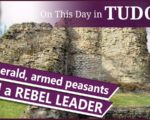
  • 21 October – A herald, armed peasants and a rebel leader

    On this day in Tudor history, 21st October 1536, during the Pilgrimage of Grace rebellion, Lancaster Herald had an encounter with armed peasants on his way to Pontefract Castle and then met with rebel leader, Robert Aske, at the castle. The meeting didn’t go well, with Aske putting his foot down and not allowing the herald to complete his mission.

    What was going on? Who was Lancaster Herald? What was his mission?

    Find out more about the situation at Pontefract in today’s talk.

    [Read More...]
  • 17 October – An English spy who suffered torture and execution in Rome

    On this day in history, 17th October 1560, spy and Protestant martyr, Walter Marsh was baptised at St Stephen’s Church in London.

    Marsh came to a sticky end, being burned to death in Rome’s Campo dei Fiori after having his tongue cut out, his hand cut off and being tortured with burning torches. He had been accused of being paid by Queen Elizabeth I to spy on Catholics and of showing contempt for the Eucharist.

    Find out more about Walter Marsh, how he’d come to be in Rome and what he’d done to upset the authorities, in today’s talk.

    [Read More...]
  • 16 October – A meeting between two kings is arranged

    On this day in Tudor history, 16th October 1532, while Henry VIII and Anne Boleyn, Marquess of Pembroke, were on their visit to Calais, English nobles met French nobles to arrange a meeting between the King of England and his French counterpart, King Francis I.

    In today’s talk, I give details on this event, who was there, what happened, and why Henry VIII and Anne Boleyn had gone to Calais.

    [Read More...]
  • 4 October – Sir Francis Bigod and his rebellion

    On this day in Tudor history, 4th October 1507, Sir Francis Bigod, was born at Seaton, in Hinderwell, Yorkshire.

    Bigod led an uprising in Yorkshire in January 1537, Bigod’s Rebellion, after the rebels of the Pilgrimage of Grace had been dispersed. But who was Bigod? Why would an evangelical reformer become involved with the Pilgrimage of Grace? What was his rebellion about and what happened to him?

    Find out more about Sir Francis Bigod and Bigod’s Rebellion in today’s talk.

    [Read More...]