The Tudor Society

YOUR SEARCH UNCOVERED 2372 RESULTS

  • A Tudor Power Grab

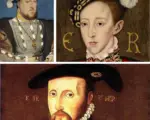
    Henry VIII, Edward VI, and Edward Seymour

    Henry VIII, one of England’s most famous monarchs, died on 28th January 1547 at the age of 55. His death, however, was not announced to the public immediately.

    Why?

    Well, the delay allowed his closest advisors and executors to figure out their next steps and secure their positions in this sudden transition of power.

    Henry’s death was formally announced three days later, on this day in Tudor history, 31st January 1547, by Thomas Wriothesley, his Lord Chancellor. Chronicler and Windsor Herald Charles Wriothesley recorded the momentous occasion, describing how the proclamation was made in Westminster Hall by Garter King of Arms and other heralds, declaring Edward VI as King of England, France, and Ireland, Supreme Head of the Church, and Defender of the Faith.

    [Read More...]
  • A birth, death and accession

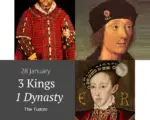
    Henry VV, Henry VIII and Edward VI

    Today is a date packed with significance in Tudor history – it’s Henry VII’s birthday, the anniversary of the death of Henry VIII, and the anniversary of the accession of Edward VI.

    Let’s take a closer look at how these three monumental events shaped the Tudor dynasty.

    First, let’s go back to 28th January 1457, when Henry Tudor was born at Pembroke Castle in Wales.

    [Read More...]
  • Did Archbishop Thomas Cranmer keep a secret wife in a box?

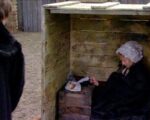
    Still from the Tudors series showing Cranmer's wife in a box

    Did Thomas Cranmer, Archbishop of Canterbury, keep his secret wife in a ventilated chest?

    Well, yes, according to his Catholic detractors!

    But was there any truth in their claims, and where does the story come from?

    In 1532, Thomas Cranmer, who wasn’t yet Archbishop of Canterbury, was serving King Henry VIII as the resident ambassador at the court of Charles V, Holy Roman Emperor. While he was with the emperor in Nuremberg, Cranmer met the city’s leading Lutheran preacher, Andreas Osiander, and the two became firm friends. Cranmer visited Osiander’s house often and at some point he met Osiander’s wife’s niece, Margarete, and that summer, despite the fact that he was an ordained priest, and was, therefore, supposed to remain celibate, Cranmer married her.

    [Read More...]
  • The Dramatic Rise and Fall of Edward Seymour

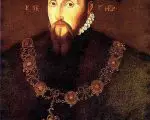
    Portrait of Edward Seymour as 1st Earl of Hertford (c.1537), wearing the Collar of the Order of the Garter. By unknown artist, Longleat House, Wiltshire.

    Edward Seymour, Duke of Somerset and Lord Protector of England, was the most powerful man in the country during Edward VI’s reign. But how did the king’s uncle go from ruling in all but name to losing his head on Tower Hill on this day in 1552?

    His is a story of ambition, betrayal, rebellion, and leadership gone wrong.

    Let me tell you more…

    Edward Seymour’s rise to power was nothing short of meteoric. As a trusted military commander, a staunch Protestant reformer, and, perhaps most importantly, the uncle of the young King Edward VI, he was perfectly positioned to influence the Tudor court. His closeness to Henry VIII in the king’s final years helped him secure his place among England’s most powerful men.

    [Read More...]
  • Eustace Chapuys – diplomat, protector, and Mary I’s unsung hero

    Eustace Chapuys

    On this day in Tudor history, 21st January 1556, former imperial ambassador, Eustace Chapuys, died in Louvain (Leuven) in Belgium, the place he had retired to in 1549. He was laid to rest in the chapel of Louvain College, the college he had founded following his retirement.

    Chapuys, who was born between 1490 and 1492 and was the second son of Louis Chapuys, a notary of Annecy, in the duchy of Savoy, joined the imperial service in 1527. Two years later, in September 1529, he arrived in England to act as advisor to the emperor’s aunt, Catherine of Aragon, in the negotiations regarding the annulment of her marriage to Henry VIII. He was her link to the emperor and to Rome. He became Catherine’s champion, preparing Catherine’s formal protest when Cranmer summoned her to his special court in 1533, a court that ruled her marriage to the king invalid, and in 1534 he acted for Catherine’s daughter, Mary, when he drew up her protest against the Act of Succession. He wasn’t only their staunch supporter and go-between, he became their friend, and I’d go as far as to say that he became a father figure to Mary.

    [Read More...]
  • Sir Thomas More – The Tudor Court’s Most Loyal – and Doomed – Servant

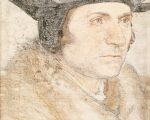
    Sketch of Sir Thomas More by Hans Holbein the Younger

    Did you know that Sir Thomas More knew the risks of serving King Henry VIII, knew that it could cost him his head, and yet he chose to serve him anyway?

    Thomas More wasn’t just a lawyer or a statesman. He was one of the most brilliant minds of his time—a humanist who believed in reason, faith, and justice. But he also had a sharp insight into human nature, particularly that of the king he served.

    [Read More...]
  • Tudor Clockmaker Bartholomew Newsam – A Gifted Man

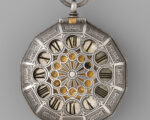
    Repeater watch and key ca. 1565 by Bartholomew Newsam, Met Museum

    Today, I’m exploring the life of a remarkable yet forgotten craftsman.

    On this day in Tudor history, 17th January 1587, Bartholomew Newsam died. He was buried in the church of St Mary-le-Strand, the parish in which he lived and worked. He was in his fifties at his death. His life spanned the reigns of five monarchs: Henry VIII, Edward VI, Lady Jane Grey, Mary I, and Elizabeth I—a time of immense change and innovation.

    Newsam was more than just a craftsman—he was a trailblazer in English clockmaking, a skill that was incredibly specialised in Tudor times.
    While most clocks were imported from Europe, Newsam stood out as one of the first English clockmakers to gain royal recognition.

    [Read More...]
  • Sir Anthony Denny

    Sir Anthony Denny

    Sir Anthony Denny was born on this day in Tudor history, the 16th January 1501, in the reign of King Henry VII, at Cheshunt in Hertfordshire. He was the second son of Sir Edmund Denny, Baron of the Exchequer to Henry VIII, and his wife, Mary Troutbeck.

    Denny was educated at St Paul’s School, London, before moving on to St John’s College, Cambridge.

    Following employment in the service of Sir Francis Bryan, a man known as the “Vicar of Hell”, By 1533, he’d secured a place in Henry VIII’s inner sanctum—the privy chamber—a realm reserved for the king’s most trusted men, and he was made a yeoman of the wardrobe in 1536. He rose to become keeper of the privy purse in 1542 and then in 1546, first chief gentleman of the privy chamber and groom of the stool. Groom of the Stool may sound like a disgusting job to us, as it involved helping the king with his toilet habits, but it also meant intimate access to the king and influence over royal decisions. In 1540, following the king’s doomed marriage to Anne of Cleves, Denny was one of those in whom the king confided his unhappiness in the marriage.

    [Read More...]
  • Charles Brandon and Mary Tudor’s Scandalous Marriage

    Charles Brandon and Mary Tudor

    On this day in Tudor history, 14th January 1515, in the reign of King Henry VIII, the king sent his best friend, Charles Brandon, Duke of Suffolk, on a diplomatic mission. His task? To escort the king’s recently widowed sister, Mary Tudor, Queen of France, back to England.

    But things didn’t go to plan… because Mary and Brandon had a secret—and scandalous—plan of their own.

    [Read More...]
  • Jane Dormer, Duchess of Feria and a leader of exiles

    On this day in history, in 1613, Jane Dormer, Duchess of Feria, died in Spain. She was buried in the monastery of Santa Clara at Zafra.

    Jane had a fascinating life, going from being one queen’s close confidante to fleeing another queen’s reign, and leading Catholic exiles abroad. Let me tell you more about her.

    Jane was born on 6th January 1538, in the reign of King Henry VIII, at Eythrope in Buckinghamshire. She was the daughter of Sir William Dormer and his first wife, Mary Sidney. Following her mother’s death in 1542, Jane was brought up by her paternal grandmother, Jane, Lady Dormer, and was given a Catholic upbringing, and in 1547, when she was just nine years old, she was admitted into the household of Princess Mary.

    [Read More...]
  • William Howard, 1st Baron Howard of Effingham, a Tudor Survivor

    Portrait of William Howard, 1st Baron Howard of Effingham, English School.

    On this day in Tudor history, 12th January 1573, in the reign of Queen Elizabeth I, William Howard, 1st Baron Howard of Effingham, died at Hampton Court Palace. The diplomat, soldier and naval commander was buried at Reigate Church.

    Howard was born in around 1510 and was the fourth son of Thomas Howard, 2nd Duke of Norfolk, and his second wife, Agnes Tilney, making him a half-brother of the powerful Thomas Howard, 3rd Duke of Norfolk, and the half-uncle of Queens Anne Boleyn and Catherine Howard.

    He was educated at Cambridge before joining the royal court, beginning his career there as Anne Boleyn rose to power. In October 1532, he accompanied Henry VIII and Anne, who had just been raised to the peerage as Marquess of Pembroke, on their trip to France to gain King Francis I’s support for their union. Then, in 1533, following Anne’s marriage to the king, he filled in as Earl Marshal, for her coronation celebrations, the 3rd Duke of Norfolk being in France at the time.

    [Read More...]
  • The Flirtation that shocked Europe – Charles Brandon and Margaret of Austria

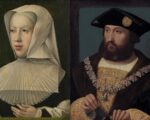
    Margaret of Austria and Charles Brandon

    What happens when a Tudor bad boy meets a powerful Habsburg duchess? Scandal, of course!

    On this day in Tudor history, 10th January 1480, Margaret of Austria, Duchess of Savoy and regent of the Habsburg Netherlands, was born. Margaret was a remarkable woman—an accomplished ruler and a central figure in European politics. But in 1513, during a moment of celebration after Henry VIII’s victory in France, Margaret found herself at the centre of a scandal thanks to none other than Charles Brandon, Duke of Suffolk.

    Flirtation, a stolen ring, and a royal joke gone wrong—what started as innocent courtly love spiralled into a full-blown international incident.

    [Read More...]
  • Two Queens, One Tower, and a Royal Physician

    Thumbnail for my video on Bathasar Giercy

    What do Catherine of Aragon, Anne Boleyn, and the Tower of London have in common? Balthasar Guercy, an Italian physician who served both queens—and found himself imprisoned for his beliefs.

    Originally from Milan, Guercy rose to prominence at the Tudor court, healing some of the most powerful figures of the day. But in 1543, he was arrested for supporting papal authority, a dangerous stance under Henry VIII’s reign. Facing potential execution, Guercy’s life hung in the balance… until Holy Roman Emperor Charles V stepped in to save him.

    [Read More...]
  • A New Year, a New King

    Thumbnail for my video showing King Louis XII

    On this day in Tudor history, 1st January 1515, King Louis XII of France died at just 52 years old, less than three months into his marriage to eighteen-year-old Mary Tudor, sister of King Henry VIII and daughter of the late King Henry VII. His throne was inherited by Francis of Angoulême, who became King Francis I.

    Was Louis’ death due to illness or, as the French people whispered, the toll of overexerting himself in hopes of securing an heir?

    [Read More...]
  • #OTD in Tudor history – 27 December

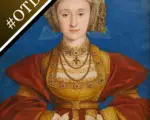
    Anne of Cleves

    On this day in Tudor history, 27th December, Anne of Cleves landed at Deal in Kent in preparation for her marriage to Henry VIII (1539), and scholar and Puritan Katherin Killigrew (née Cooke) died (1583)…

    [Read More...]
  • #OTD in Tudor history – 26 December

    Henry VIII

    On this day in Tudor history, Protestant exile and businesswoman Rose Lok was born in London (1526), Henry VIII made some changes to his will (1546), and the Feast of St Stephen was celebrated…

    [Read More...]
  • #OTD in Tudor history – 24 December

    Henry VIII

    On this day in Tudor history, 24th December, King Henry VIII made his final speech to Parliament (1545); Sir Thomas Cornwallis, comptroller of the household of Mary I and member of Parliament, died (1604); and Christmas Eve was celebrated…

    [Read More...]
  • #OTD in Tudor history – 20 December

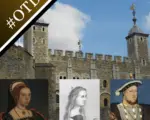
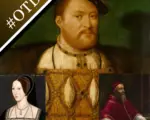
    Photo of the Tower of London with portraits of Catherine Howard, Agnes Tilney and Henry VIII

    On this day in Tudor history, 20th December, Catherine Howard’s step-grandmother begged Henry VIII for forgiveness (1541), and Edward Arden was hanged, drawn and quartered for allegedly plotting with his son-in-law to kill the queen (1583)…

    [Read More...]
  • #OTD in Tudor history – 17 December

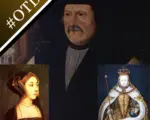
    Archbishop Matthew Parker and portraits of Anne Boleyn and Elizabeth I

    On this day in Tudor history, 17th December, Pope Paul III announced the excommunication of King Henry VIII (1538), and Anne Boleyn’s former chaplain, Matthew Parker, was consecrated as Elizabeth I’s Archbishop of Canterbury (1559)…

    [Read More...]
  • #OTD in Tudor history – 16 December

    Portrait of Catherine of Aragon and a photo of the Archbishop's Palace at Alcala de Henares

    On this day in Tudor history, Catherine of Aragon, Henry VIII’s first queen consort, was born at Alcalá de Henares (1485), and soldier and courtier George Grey, 2nd Earl of Kent, died (1503)…

    [Read More...]
  • #OTD in Tudor history – 11 December

    A miniature of Anne of Cleves and a portrait of Robert Dudley

    On this day in Tudor history, 11th December, Henry VIII’s bride-to-be, Anne of Cleves, was received in a lavish ceremony at Gravelines (1539), and Lady Douglas Sheffield, one-time lover (and perhaps wife!) of Robert Dudley, and the mother of his illegitimate son, was buried (1608)…

    [Read More...]
  • #OTD in Tudor history – 9 December

    Catherine Howard and Agnes Tilney

    On this day in Tudor history, 9th December, Sir Edward Neville was executed for treason for allegedly conspiring against King Henry VIII (1538), and Queen Catherine Howard’s step-grandmother, the Dowager Duchess of Norfolk, was questioned (1541)…

    [Read More...]
  • #OTD in Tudor history – 30 November

    Elizabeth I in her parliamentary robes

    On this day in Tudor history, 30th November, Henry VIII was reproached by the two women in his life: his wife, Catherine of Aragon, and the woman he wanted to marry, Anne Boleyn (1529), and Elizabeth I delivered her famous Golden Speech to the House of Commons (1601)…

    [Read More...]
  • #OTD in Tudor history – 26 November

    Henry Fitzroy and Mary Howard

    On this day in Tudor history, 26th November, Henry VIII’s 14-year-old illegitimate son, Henry Fitzroy, Duke of Richmond and Somerset, married Lady Mary Howard, daughter of the Duke of Norfolk (1533); and the first men to be executed under the new treason laws against Jesuits in Elizabeth I’s reign were hanged at York (1585)…

    [Read More...]
  • #OTD in Tudor history – 22 November

    Dr William Butts

    On this day in Tudor history, 22nd November, Henry VIII’s trusted physician and confidant Sir William Butts died at Fulham Manor (1545); and naval commander, privateer and explorer Sir Martin Frobisher died of gangrene (1594) after suffering an injury in hand-to-hand combat…

    [Read More...]
  • #OTD in Tudor history – 15 November

    Portraits of Henry VIII, Anne Boleyn and Pope Clement VII

    On this day in Tudor history, 15th November, Katherine of York, Countess of Devon, died at Tiverton Castle (1527); and Pope Clement VII threatened Henry VIII and Anne Boleyn with excommunication because Henry VIII had defied the pope’s instructions (1532)…

    [Read More...]
  • #OTD in Tudor history – 14 November

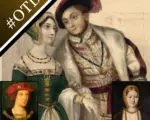
    Portraits of Anne Boleyn and Henry VIII, Arthur Tudor, and Catherine of Aragon

    On this day in Tudor history, 14th November, Catherine of Aragon married Arthur Tudor, Prince of Wales (1501); Henry VIII may have married Anne Boleyn (1532); and an inventory was taken of Thomas Culpeper’s “goods and chattels, lands and fees” (1541)…

    [Read More...]
  • #OTD in Tudor history – 8 November

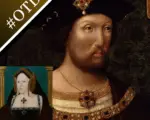
    Portraits of Henry VIII and Catherine of Aragon

    On this day in Tudor history, 8th November, Henry VIII made a rather strange speech explaining his troubled conscience about his marriage to Catherine of Aragon (1528); and scholar, literary patron and chamberlain to Catherine of Aragon, William Blount, 4th Baron Mountjoy, died at Sutton on the Hill (1534)…

    [Read More...]
  • #OTD in Tudor history – 6 November

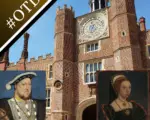
    A photo of Hampton Court Palace and portraits of Henry VIII and Catherine Howard

    On this day in Tudor history, 6th November, Catherine of Aragon met Arthur Tudor, Prince of Wales, for the first time (1501); and Catherine Howard, Henry VIII’s fifth wife, was abandoned by her husband the king at Hampton Court Palace. She would never see him again (1541)…

    [Read More...]
  • #OTD in Tudor history – 5 November

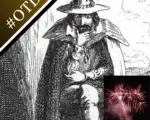
    Guy Fawkes and fireworks

    On this day in history, 5th November, Mary Tudor, sister of Henry VIII, was crowned Queen of France at Saint-Denis (1514); and Gunpowder Plot conspirator, Guy Fawkes, was discovered with 36 barrels of gunpowder in a cellar beneath Westminster (1605)…

    [Read More...]